

Whether you are gearing up for a brutal winter, heading to the gym, or selecting protective gear for a DIY project, nothing ruins the experience faster than a pair of gloves that don’t fit. If they’re too tight, you lose circulation and dexterity; if they’re too loose, they become a safety hazard. The key to achieving a perfect fit is knowing how to measure glove size. In this guide, we will walk through the professional hand measurement techniques used by tailors and manufacturers to ensure you get the perfect fit every single time.
Understanding Glove Sizes
Glove sizing isn’t just about small, medium, and large. Because hands differ significantly in bone structure and muscle density, brands use specific measurements—usually inches—to categorize their products.
Types of Glove Sizes: Men’s, Women’s, and Youth
It is a common misconception that a “medium” is universal. In reality, the proportions differ:
- Men’s Glove Sizes: Generally designed with wider palms and thicker fingers.
- Women’s Glove Sizes: Tailored for narrower palms and longer, more slender fingers.
- Youth Glove Sizes: Focused on smaller hand circumferences and shorter finger lengths to accommodate growing hands.
Importance of Glove Size for Comfort and Performance
A proper fit isn’t just about comfort; it’s about performance. In sports like baseball or golf, the wrong size can affect your grip. An ill-fitting glove in industrial work can become entangled in machinery or fail to offer the required thermal protection. Learn more about the importance of glove size for comfort and performance
How to Measure Hands for Glove Sizing
Before you browse a glove size chart, you need accurate data. Most people make the mistake of just “eyeballing” it, but professional hand measurement techniques require precision.
Tools Needed for Measuring
You don’t need a professional workshop to get this right. Grab these items:
- A flexible fabric measuring tape (tailor’s tape).
- If you don’t have fabric tape, use a piece of string and a ruler.
- A pen and paper to record your numbers.
Step-by-Step Measuring Techniques
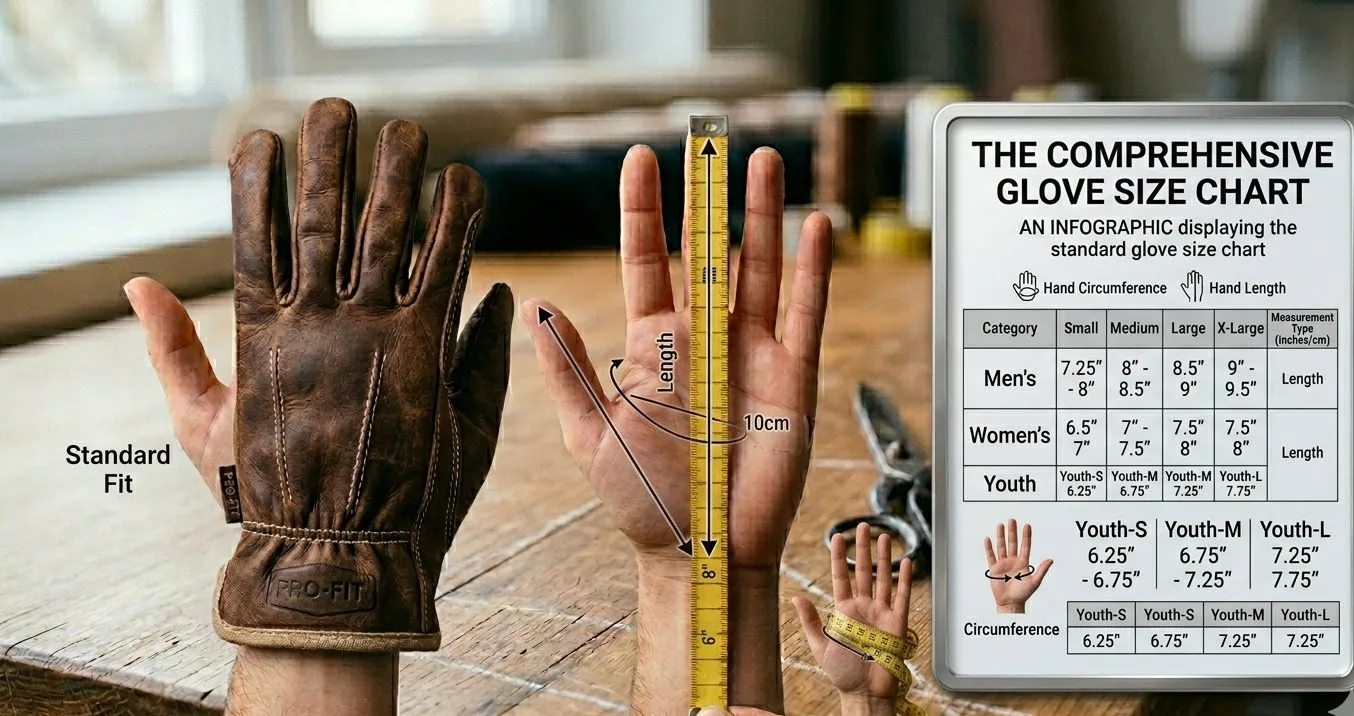
There are two primary measurements you need to determine glove size: Circumference and Length.
1. Measuring the Circumference (The Most Important Step)
- Open your dominant hand (if you are right-handed, measure your right hand).
- Wrap the tape measure around your palm at the widest part (usually just below the knuckles, excluding the thumb).
- Make a loose fist and note the measurement. Most manufacturers recommend measuring the hand slightly clenched to ensure the glove doesn’t pinch when you move it.
2. Measuring the Length
- Straighten your fingers.
- Measure from the tip of your middle finger down to the base of your palm (where your hand meets your wrist).
Pro Tip: If your hand circumference and length fall into different size categories, always go with the larger size for the best comfort.
Interpreting the Glove Size Chart
Once you have your measurements in inches or centimeters, you can refer to a glove size chart. While every brand (like Wells Lamont or Dents) may vary slightly, the following are the standard US industry benchmarks.
Standard Glove Size Reference Table
| Size | Men’s (Circumference) | Women’s (Circumference) | Youth (Age/Size) |
| XS | 7″ – 7.5″ | 6″ – 6.5″ | 4 – 5 years |
| S | 7.5″ – 8″ | 6.5″ – 7″ | 6 – 8 years |
| M | 8.5″ – 9″ | 7″ – 7.5″ | 9 – 11 years |
| L | 9.5″ – 10″ | 7.5″ – 8″ | 12 – 14 years |
| XL | 10.5″ – 11″ | 8″ + | N/A |
Glove Size Conversion
If you are buying European luxury leather gloves or technical outdoor gear from international brands, you might encounter issues with glove size conversion.
Understanding Size Conversion Between Brands
European sizing often uses a numerical system (e.g., 7, 8, 9) based on French inches. A French inch is slightly larger than a standard inch.
- Numerical 7: Generally equates to a woman’s medium.
- Numerical 9: Generally equates to a men’s large size.
International Glove Size Standards
Always check if a brand uses unisex sizing. Unisex gloves are typically scaled to men’s proportions. If you are a woman buying a unisex glove, you should generally size down one full step.
Common Mistakes in Measuring Glove Size
Even with a tape measure in hand, errors happen. Avoid these pitfalls:
- Overlooking Hand Width vs. Finger Length: Some people have wide palms but short fingers. If this is you, look for “cadet” sizes or brands known for shorter finger designs.
- Ignoring Brand-Specific Charts: A “large” in a winter ski glove is much bulkier than a “large” in a disposable nitrile glove. Always check the specific manufacturer’s guide.
- Measuring the Wrong Hand: Your dominant hand is almost always slightly larger. Always measure the hand you use most!
Final Tips for Accurate Glove Sizing
Finding the perfect fit doesn’t have to be a challenge. By mastering how to measure hands and understanding how to read a glove size chart, you can shop with confidence. Remember: when in doubt, size up. A little extra room allows for a layer of insulating air, whereas a glove that is too tight will actually make your hands colder in the winter.
FAQs
What is the easiest way to measure glove size?
The easiest way to measure glove size is to wrap a measuring tape around the widest part of your palm, just below the knuckles, excluding the thumb. Compare the measurement with a glove size chart to find your correct size.
Should I measure my dominant hand for glove sizing?
Yes. Most manufacturers recommend measuring your dominant hand because it is usually slightly larger and provides a more accurate glove fit.
What if my hand measurement falls between two glove sizes?
If your measurement falls between two sizes, choose the larger size for a more comfortable fit and better hand movement.
How do I measure my hand without a measuring tape?
You can wrap a piece of string around your palm, mark the length, and then measure it with a ruler to determine your hand circumference.
Does glove size vary between brands?
Yes. Glove sizing can vary between manufacturers. Always compare your hand measurements with the specific size chart provided by the brand.
Why is proper glove sizing important?
Proper glove sizing improves comfort, grip, dexterity, and safety while reducing hand fatigue during work or daily use.
Are men’s and women’s glove sizes different?
Men’s and women’s glove sizes are often based on different hand proportions. Always refer to the manufacturer’s size chart for accurate sizing.
Can I use the same glove size for all types of gloves?
Not always. Work gloves, winter gloves, leather gloves, and disposable gloves may fit differently depending on their material and intended use.