


Winter work doesn’t stop when temperatures drop. Whether you’re on a construction site in Minnesota, maintaining utilities in Alberta, or working in cold storage in the Pacific Northwest, keeping your hands warm and dry while maintaining dexterity is critical for both safety and productivity.
Choosing the right insulated winter work gloves can mean the difference between comfortable, efficient work and serious cold-related injuries.
With hundreds of winter work gloves on the market, from basic fleece-lined options to advanced Bio Liner technology, how do you select the best insulated leather work gloves for your specific needs?
This comprehensive guide compares leather winter work gloves across insulation types, temperature ratings, and industry applications to help you make an informed decision for the 2026-2027 winter season.
📋 Table of Contents:
- Quick Comparison: Winter Work Glove Types
- Understanding Insulation Technologies
- Leather vs Synthetic Winter Work Gloves
- Waterproof vs Water Resistant: What You Need to Know
- Temperature Rating Guide
- Best Winter Work Gloves by Industry
- Top Features to Consider
- Bio Liner vs Thinsulate vs Fleece Comparison
- How to Choose the Right Winter Work Gloves
- USA & Canada Winter PPE Standards
- Bulk Purchasing Guide for Businesses
- Care & Maintenance
- FAQ
Quick Comparison: Winter Work Glove Types
Before diving into details, here’s a quick overview of the main types of insulated work gloves available for winter 2026-2027:
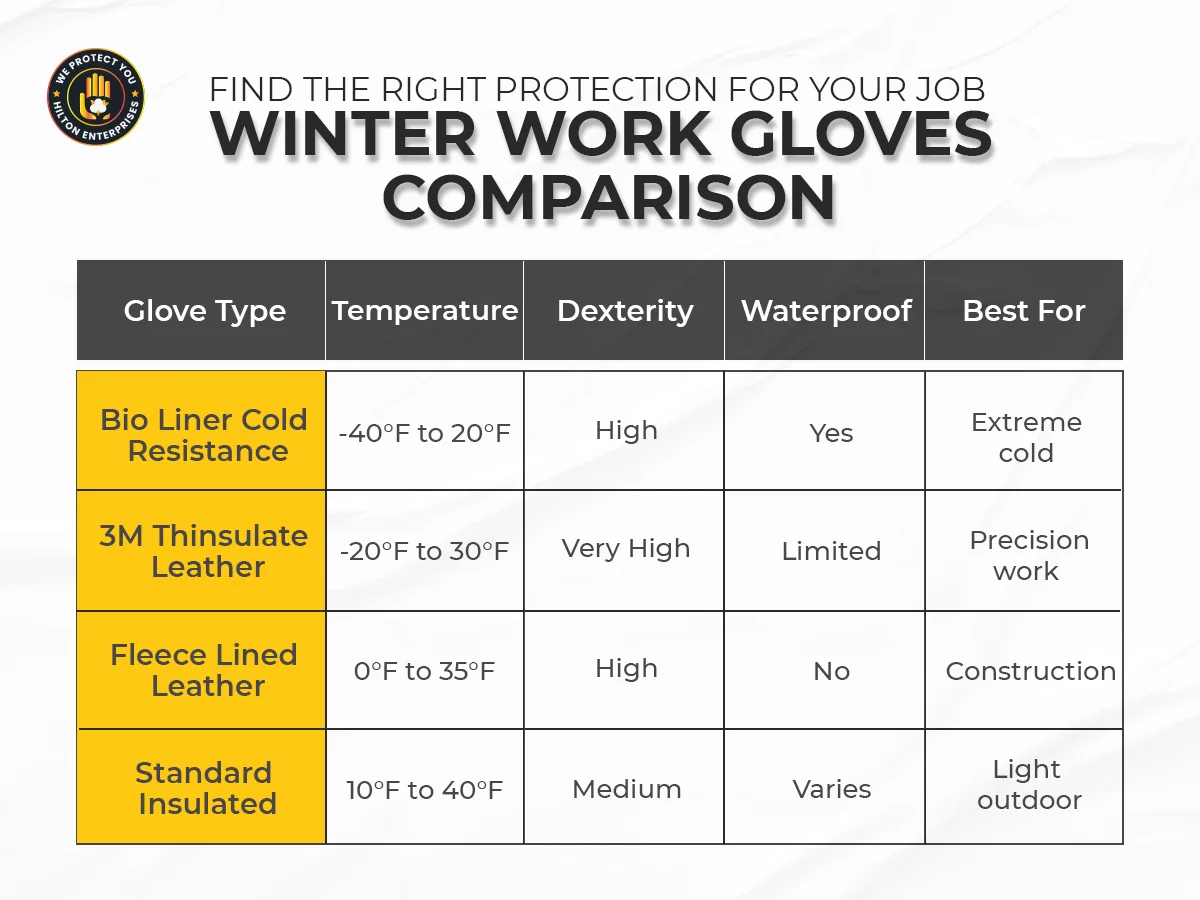
Key Insight: The “warmest” glove isn’t always the best choice. Extreme insulation reduces dexterity, making tasks slower and potentially more dangerous. Match your insulation level to your actual working conditions and task requirements.
Hilton Glove Advantage: Our Bio Liner, Thinsulate, and Fleece Lined gloves are competitively priced within these market ranges, with significant volume discounts available for bulk orders.
Request a custom quote →
Understanding Insulation Technologies
Modern winter work gloves use sophisticated insulation technologies that go far beyond simple fabric lining. Understanding these technologies helps you select gloves that provide optimal warmth without sacrificing the dexterity needed for safe, efficient work.
Bio Liner Insulation Technology
Bio Liner represents advanced cold weather protection engineered for extreme conditions. This proprietary insulation system combines synthetic hollow-core fibers that trap warm air while allowing moisture vapor to escape, keeping hands warm and dry even during high-exertion activities in sub-zero temperatures.
How Bio Liner Works:
- Hollow fiber structure creates microscopic air pockets that retain body heat
- Moisture-wicking properties pull sweat away from skin to prevent cold, clammy hands
- Breathable design prevents overheating during physical work
- Temperature range: Effective from -40°F to 20°F
Best Applications:
- Oil field operations in North Dakota, Alaska, or Alberta
- Utility maintenance in extreme cold regions
- Cold storage and freezer work (year-round applications)
- Winter construction in Canadian provinces
- Emergency response in severe weather conditions
Bio Liner gloves typically use full-grain or split leather outer shells, providing excellent abrasion resistance, while the advanced insulation handles temperature extremes.
3M Thinsulate: The Gold Standard
3M Thinsulate has been the benchmark for winter insulation since its introduction, offering an impressive warmth-to-thickness ratio. These work gloves maintain dexterity while providing substantial cold weather protection, critical for mechanics, electricians, and precision workers.
Thinsulate Technology Benefits:
- Thin profile (40g-200g options) maintains hand mobility
- Microfiber construction traps more air in less space than traditional insulation
- Moisture resistance continues to insulate even when damp
- Temperature range: -20°F to 30°F (varies by gram weight)
Gram Weights Explained:
- 40g Thinsulate: Light insulation for moderately cold conditions (30°F-40°F)
- 100g Thinsulate: Medium insulation for cold weather work (10°F-30°F)
- 200g Thinsulate: Heavy insulation for extreme cold (-20°F to 10°F)
Best For: Workers who need to maintain fine motor skills while working in cold weather. Thinsulate leather gloves excel in automotive repair, precision assembly, electrical work, and skilled trades where touch sensitivity matters.
Fleece Lined Leather Gloves
Fleece lining offers a cost-effective insulation solution that balances warmth, comfort, and affordability. While not as advanced as Bio Liner or as efficient as Thinsulate, fleece lined leather work gloves provide reliable protection for the majority of winter work applications across North America.
Fleece Insulation Characteristics:
- Soft, comfortable against skin (reduces hand fatigue)
- Good breathability for moderate-exertion work
- Quick-drying when exposed to moisture
- Temperature range: 0°F to 35°F
- Budget-friendly option for large workforces
Common Fleece Materials:
- Polyester fleece: Most common, good moisture-wicking
- Cotton/poly blend: Softer feel, adequate warmth
- Acrylic fleece: Budget option, less breathable
Best Applications: Construction labor, warehousing, landscaping, general outdoor maintenance, and situations where gloves may be lost or damaged frequently, making replacement cost a consideration.
Leather vs Synthetic Winter Work Gloves
The outer shell material significantly impacts glove performance, durability, and comfort. While synthetic options have improved, insulated leather work gloves remain the preferred choice for demanding industrial applications.
Why Leather Excels in Winter Work
1. Superior Abrasion Resistance:
Leather naturally resists wear from tools, equipment, and rough surfaces. Full-grain leather work gloves can withstand repeated abrasion that would quickly destroy synthetic materials, making them more cost-effective over time despite higher upfront costs.
2. Natural Breathability:
Leather “breathes” better than most synthetics, allowing moisture vapor to escape while blocking wind. This prevents the cold, clammy feeling that develops when sweat is trapped inside gloves, a common problem with coated synthetic gloves.
3. Flexibility Improves with Use:
Quality leather winter work gloves break in to fit your hand’s unique shape, providing customized comfort and dexterity. Synthetic materials maintain their original stiffness or deteriorate with use.
4. Better Grip:
Leather provides superior grip on tools and equipment, especially when slightly moist. Many synthetic materials become slippery when wet, creating safety hazards.
5. Wind Resistance:
Leather blocks wind more effectively than synthetic fabrics, reducing wind chill effects. A 20°F day with 20mph winds feels like -2°F; proper wind protection is critical.
Leather Types for Winter Gloves
Full-Grain Leather (Premium):
- Source: Top layer of hide with natural grain intact
- Properties: Maximum durability, natural oils provide water resistance
- Best for: Goatskin winter gloves, premium cowhide options
- Cost: $15-$28/pair
Top-Grain Leather (High Quality):
- Source: Top layer sanded to remove imperfections
- Properties: Uniform appearance, good durability
- Best for: Professional appearance requirements
- Cost: $12-$20/pair
Split Leather (Economy):
- Source: Lower layers of hide
- Properties: More affordable, good for heavy work
- Best for: Construction winter gloves, rough applications
- Cost: $8-$15/pair
When Synthetic Makes Sense
Synthetic winter work gloves have specific advantages in certain applications:
- Chemical resistance: Some synthetics resist chemicals that damage leather
- Machine washability: Easier maintenance for food processing or medical facilities
- Vegan/ethical preferences: No animal products
- Electrical work: Certain synthetics provide better insulation (check ratings)
Reality Check: For most industrial and construction applications, insulated leather work gloves provide superior performance, durability, and long-term value compared to synthetic alternatives.
Waterproof vs Water Resistant: What You Need to Know
Understanding the difference between “waterproof” and “water resistant” is critical when selecting winter work gloves. Marketing claims can be misleading. Here’s what these terms actually mean for your hands.
Waterproof Winter Work Gloves
Technical Definition: Waterproof gloves feature a membrane (like Gore-Tex, Hipora, or proprietary barriers) that blocks liquid water while allowing water vapor (sweat) to escape.
Key Characteristics:
- Withstand continuous immersion or heavy precipitation
- Sealed seams prevent water entry at stitch lines
- Typically have waterproof membrane between the outer shell and insulation
- May reduce breathability compared to water-resistant options
Best Applications:
- Utility work in wet conditions (rain, sleet, snow removal)
- Construction during winter precipitation
- Cold storage with condensation issues
- Marine or dock work in cold weather
Temperature Trade-off: Fully waterproof construction can trap some moisture inside if you’re doing high-exertion work, potentially making your hands colder. Consider waterproof insulated work gloves only if you regularly work in wet conditions.
Water Resistant Options
Technical Definition: Water-resistant gloves repel light moisture but aren’t designed for immersion or heavy precipitation. Most quality leather winter work gloves fall into this category.
How Leather Naturally Resists Water:
- Lanolin content: Natural oils in leather repel light moisture
- Tight grain structure: Quality leather naturally sheds water initially
- Treatability: Leather accepts waterproofing treatments (waxes, oils)
Performance Expectations:
- Handles light snow, brief precipitation, and condensation
- Eventually wets through in sustained moisture exposure
- Dries relatively quickly when properly cared for
Best Applications:
- Construction in dry winter conditions
- Warehousing and logistics
- Automotive and mechanical work
- Indoor/outdoor transitional work
Making the Right Choice
Choose Waterproof When:
- Working in sustained precipitation
- Handling wet materials
- Operating in high-humidity cold storage
- Unable to retreat to dry conditions
Choose Water Resistant (Standard Leather) When:
- Working primarily in dry, cold conditions
- Prioritizing breathability and dexterity
- Budget-conscious (waterproof adds $5-$15/pair)
- Can change gloves if they get wet
Pro Tip: Many professionals keep both types, waterproof winter work gloves for wet days, and standard insulated leather for dry cold conditions. This maximizes comfort and extends glove life.
Temperature Rating Guide
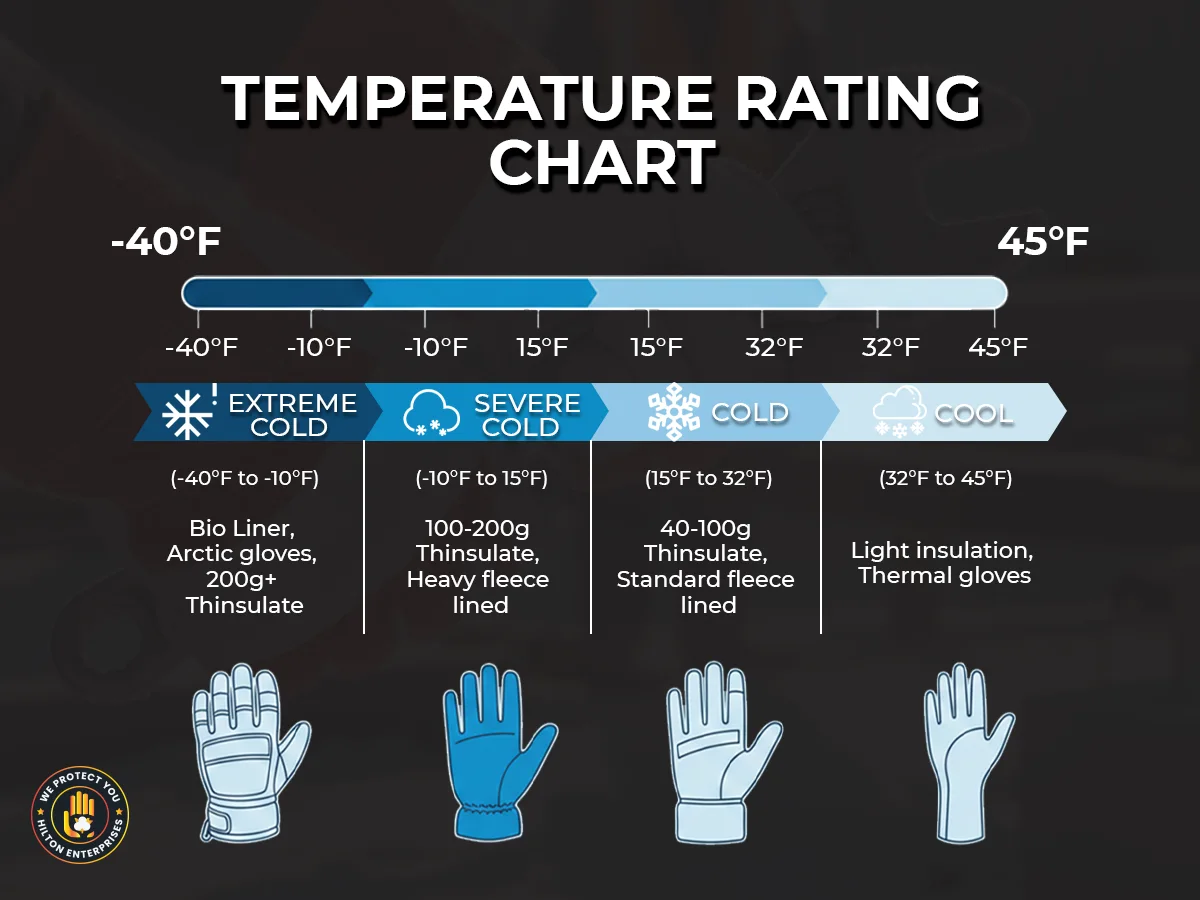
Temperature ratings help match gloves to working conditions, but actual performance depends on multiple factors beyond ambient temperature.
Understanding Temperature Ratings
What Temperature Ratings Mean:
- Lower limit: Coldest temperature where gloves maintain adequate warmth
- Comfort range: Temperatures where most users stay comfortable during moderate activity
- Upper limit: Warmest conditions before gloves cause overheating
Important: These ratings assume:
- Moderate wind speeds (5-10 mph)
- Medium physical activity level
- Average circulation/sensitivity
- Dry conditions
Temperature Zones & Glove Recommendations
Extreme Cold: -40°F to -10°F
Conditions: Arctic regions, Canadian far north in deep winter, Alaska interior, severe weather events
Recommended Gloves:
- Bio Liner Cold Resistance technology
- Heavy insulated leather (200g+ Thinsulate equivalent)
- Arctic work gloves with extended gauntlet cuffs
- Often require glove layering systems
Critical Considerations:
- Wind chill dramatically affects perceived temperature
- Circulation restrictions (tight cuffs) cause cold fingers faster than inadequate insulation
- Change gloves every 2-3 hours if continuously exposed
Real-World Example: Oil field workers in North Dakota winters (-30°F ambient) need extreme cold work gloves with Bio Liner technology. Standard fleece lined gloves would be dangerously inadequate.
Severe Cold: -10°F to 15°F
Conditions: Northern US states, mid-winter, Canadian provinces, high-altitude work
Recommended Gloves:
- 100-200g Thinsulate leather gloves
- Heavy fleece lined leather work gloves
- Bio Liner for extended outdoor exposure
- Waterproof options if working in snow
Applications: Winter construction in Minneapolis, utility maintenance in Edmonton, outdoor manufacturing operations
Cold Weather: 15°F to 32°F
Conditions: Common winter temperatures across the northern US, southern Canada, and occasional cold snaps in mid-latitude states
Recommended Gloves:
- 40-100g Thinsulate work gloves
- Standard fleece lined leather gloves
- Lined leather work gloves
- Water-resistant options are usually sufficient
Applications: Construction winter gloves for most locations, mechanic winter gloves, and warehouse work
Cool Conditions: 32°F to 45°F
Conditions: Shoulder season weather, southern US winters, mild Canadian winters, cold storage facilities
Recommended Gloves:
- Light insulation (40g Thinsulate or thin fleece)
- Thermal work gloves without heavy insulation
- Unlined leather with good wind protection
Applications: Freezer work gloves (35°F-40°F cold storage), spring/fall outdoor work
Wind Chill Factor
Wind dramatically affects cold weather glove performance. The National Weather Service wind chill chart shows how wind makes ambient temperatures feel:
Wind Chill Examples:
- 20°F + 15mph wind = feels like 5°F
- 0°F + 20mph wind = feels like -22°F
- -20°F + 25mph wind = feels like -47°F
Implications for Glove Selection:
- Exposed worksites (roofing, towers, open fields) need gloves rated 10-20°F colder than ambient temperature
- Wind-blocking leather outer shells matter as much as insulation
- Extended gauntlet cuffs prevent wind from entering at the wrists
Best Winter Work Gloves by Industry
Different industries have unique requirements for hand protection in cold weather. Here’s what works best for major sectors.

Construction Winter Gloves
Primary Needs: Durability, dexterity for handling materials, abrasion resistance, water resistance
Recommended Options:
- Heavy-duty winter work gloves with split or full-grain leather palms
- Fleece-lined leather work gloves (best value for large crews)
- Waterproof winter work gloves for concrete work in wet conditions
- Hi-vis winter work gloves where visibility is required
Specific Applications:
- Framing/carpentry: Thinsulate gloves (100g) for tool handling dexterity
- Concrete/masonry: Waterproof, insulated work gloves, easy to clean
- Roofing: Wind-resistant with good grip, extended cuffs
- General labor: Fleece lined leather, cost-effective for replacement
Temperature Considerations: Construction sites often have windchill issues. Choose gloves rated 10°F below ambient temperature for exposed sites.
USA/Canada Compliance: ANSI Z359 fall protection standards require gloves that don’t compromise grip. CCOHS recommends rotating workers indoors every 2 hours in severe cold.
Mechanic & Automotive Winter Gloves
Primary Needs: Dexterity, tactile sensitivity, oil/grease resistance, tool grip
Recommended Options:
- Thinsulate leather gloves (40-100g) for maximum dexterity
- Mechanic-style winter gloves with synthetic leather palms (better oil resistance)
- Touchscreen winter work gloves for modern diagnostic equipment
Why Mechanics Need Different Gloves:
- Oil exposure: Standard fleece absorbs oil; specialized liners resist it
- Touch sensitivity: Must feel bolt threads, electrical connections
- Tool grip: Thin leather with good tactile feedback
Cold Shop Challenges: Many automotive shops are unheated or poorly heated. Mechanics need warm work gloves that don’t impair their ability to handle small fasteners and connectors.
Real-World Feedback: Mechanics consistently rate 40-100g Thinsulate leather gloves as the best winter option, rejecting heavily insulated gloves as “too clumsy for working on engines.”
Electrician Winter Gloves
Primary Needs: Electrical safety ratings, dexterity for wire handling, compliance with NFPA 70E
Critical Warning: Insulated winter work gloves are NOT electrical safety gloves. Use rated electrical gloves as PPE, with winter gloves as secondary protection over electrical gloves when needed.
Recommended Options:
- Thin insulated leather gloves (40g Thinsulate) for non-energized work
- Arc-rated winter gloves for environments with flash hazards
- Electrical-rated leather protectors worn over rubber electrical gloves
Compliance Requirements:
- OSHA 1910.269: Electrical workers must use gloves rated for voltage levels
- NFPA 70E: Arc flash protection requirements
- ASTM D120: Electrical glove standards (separate from winter gloves)
Cold Storage & Freezer Work Gloves
Primary Needs: Year-round extreme cold protection, moisture resistance, dexterity for handling packages
Recommended Options:
- Freezer work gloves with Bio Liner technology
- Heavy insulated options (200g+ equivalent)
- Waterproof insulated work gloves (condensation issues)
Unique Challenges:
- Constant exposure: Unlike outdoor work, no warm-up breaks
- Temperature shocks: Moving between -10°F freezers and 70°F offices
- Repetitive motion: Picking and packing require sustained dexterity
Temperature Ranges:
- Walk-in coolers: 35-40°F (light insulation adequate)
- Standard freezers: 0°F to -10°F (heavy insulation required)
- Deep freeze storage: -20°F to -40°F (extreme cold gloves necessary)
Pro Tip: Cold storage workers should have two glove sets, one in use, one warming to room temperature. Wearing cold gloves straight from the freezer reduces initial warmth.
Utilities & Infrastructure Maintenance
Primary Needs: All-weather protection, excellent grip on tools and cables, cut resistance, impact protection
Recommended Options:
- Heavy duty winter work gloves with reinforced palms
- Impact resistant winter gloves for utility work
- Extended gauntlet cuffs to seal with jacket sleeves
Specific Utilities:
- Power line work: Cut-resistant with Kevlar backing over heavy insulation
- Gas utilities: Anti-static materials, good grip on wrenches
- Water/sewer: Fully waterproof with chemical resistance
Regional Requirements: Northern utilities require gloves rated to -40°F for emergency repairs during weather events. Southern utilities may use lighter insulation, but still need wind and water protection.
Oil & Gas Industry
Primary Needs: Extreme cold protection, chemical resistance, flame resistance, high durability
Recommended Options:
- Oil field winter gloves with Bio Liner technology
- Flame-resistant winter gloves (meets NFPA 2112)
- Leather palm winter gloves with reinforced fingertips
Unique Requirements:
- Extended outdoor exposure: Workers spend full shifts in extreme cold
- Hydrocarbon exposure: Must resist oil, grease, and petroleum products
- Safety compliance: Alberta’s CSA Z1003 or US equivalent standards
Climate Extremes:
- North Dakota Bakken: -30°F to -40°F winter work temperatures
- Alaska North Slope: -50°F recorded temperatures
- Alberta oil sands: -40°F common in January/February
Cost Consideration: Oil & gas workers typically need premium gloves ($20-$28/pair) due to extreme conditions and safety requirements. Budget fleece options are inadequate and potentially dangerous.
Top Features to Consider
Beyond basic insulation and material, several key features separate adequate winter work gloves from exceptional ones. Understanding these features helps you select gloves optimized for your specific working conditions.
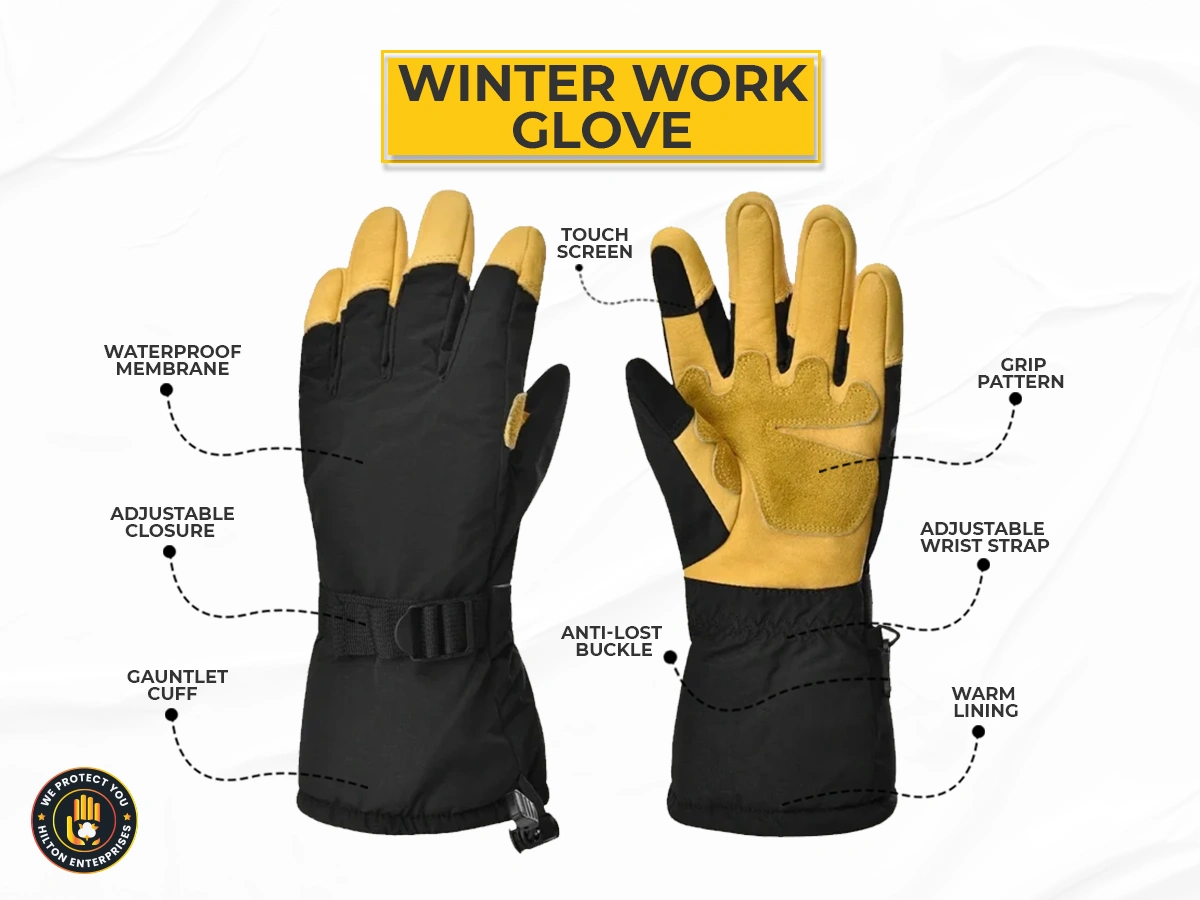
Cuff Design & Length
Standard Cuff (2-3 inches):
- Covers the wrist joint
- Good for indoor/outdoor transitional work
- Easier to put on/remove quickly
- May allow cold air entry at the wrist
Gauntlet Cuff (4-6 inches):
- Extends over jacket/coat sleeves
- Blocks wind and snow entry
- Essential for extreme cold or outdoor work
- Requires proper sizing to avoid circulation restriction
Elastic vs Knit Wrist:
- Elastic: Secure seal, prevents debris entry, can restrict circulation if too tight
- Knit wrist: Comfortable, flexible, some air movement possible
- Hook-and-loop (Velcro): Adjustable seal, best for varying clothing layers
Pro Tip: For outdoor winter work, gauntlet cuffs with adjustable closures provide the best protection without compromising circulation.
Palm & Finger Reinforcement
High-wear areas need extra protection to extend glove life. Look for:
Reinforced Palm:
- Double-layer leather in high-contact areas
- Kevlar patches for extreme abrasion resistance
- Extended palm coverage up to the fingers
Finger Protection:
- Reinforced fingertips (reduce wear from gripping)
- Seamless finger construction (eliminates weak points)
- Pre-curved fingers (reduce material stress, improve comfort)
Saddle Back: Extra material across knuckles provides flexibility and protects against abrasion from tools and equipment.
Grip Technology
Maintaining a secure tool grip in cold weather is critical for safety and productivity.
Grip Enhancement Options:
- Textured leather: Natural texture provides good grip
- Synthetic leather palms: Better grip when wet or oily
- Silicone patterns: Excellent for slippery tools and equipment
- PVC dots: Budget option, adequate for dry conditions
Oil & Water Grip: Mechanics and equipment operators need gloves that maintain grip when exposed to hydraulic fluid, oils, or water. Look for synthetic leather palms or special grip coatings.
Touchscreen Compatibility
Modern work increasingly requires operating touchscreen devices, smartphones, tablets, equipment controls, and diagnostic tools.
Touchscreen Winter Work Gloves Options:
- Conductive fingertips: Thumb and index finger work with capacitive screens
- Full-hand conductivity: All fingers work (rare in work gloves)
- Trade-offs: Touchscreen materials may reduce durability
Reality Check: Touchscreen features add $3-$8 per pair. Evaluate whether your workers actually need to operate devices while gloved, or if removing gloves briefly is acceptable.
Cut Resistance Levels
Some winter work environments require cut-resistant protection in addition to thermal insulation.
ANSI Cut Resistance Levels:
- A1-A3: Light protection (assembly, warehousing)
- A4-A5: Medium protection (metal fabrication, glass handling)
- A6-A9: Heavy protection (sharp edge work, waste management)
Cut Resistant Winter Gloves Applications:
- Glass installation in cold weather
- Metal fabrication in unheated shops
- Recycling and waste management
- Food processing in cold facilities
Material Options: Kevlar-lined insulated gloves provide both thermal and cut protection, though they sacrifice some dexterity and typically cost $18-$35/pair.
Impact Protection
Utility workers, construction crews, and equipment operators may need impact-resistant winter gloves.
Impact Protection Features:
- TPR (Thermoplastic Rubber) knuckle guards: Protect against impact and pinch injuries
- Metacarpal guards: Protect the back of the hand
- Finger guards: Individual finger protection
Standards: ANSI/ISEA 138 rates impact protection. Look for Level 1 (light impact) or Level 2 (moderate impact) ratings when needed.
Trade-off: Impact protection adds bulk and reduces dexterity. Only use impact-resistant winter gloves when hazards require it.
Hi-Vis Features
Construction, roadwork, and utility maintenance often require high-visibility winter work gloves.
Hi-Vis Requirements:
- ANSI 107 compliant: Background material in fluorescent yellow-green or orange
- Reflective material: Strips or patterns for low-light visibility
- Contrast: Dark accents improve definition
Applications: Flaggers, highway work zones, nighttime construction, utility crews working near traffic
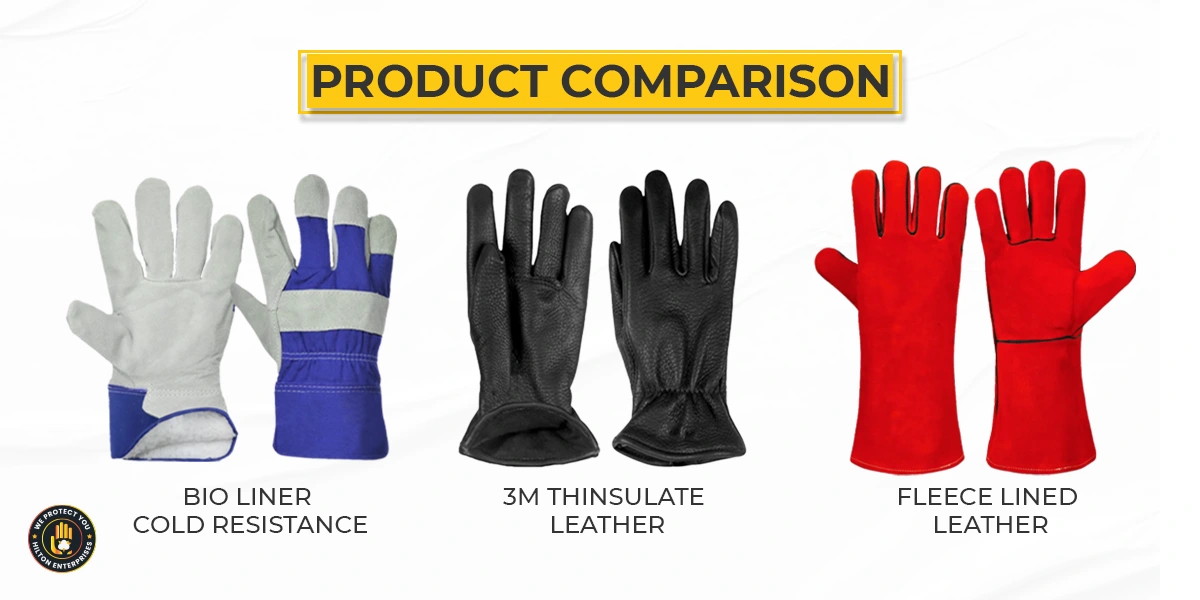
Bio Liner vs Thinsulate vs Fleece: Head-to-Head Comparison
Let’s compare the three most popular insulation technologies in detail to help you make an informed decision.
Performance Comparison Matrix
| Feature | Bio Liner | 3M Thinsulate | Fleece Lined |
| Temperature Range | -40°F to 20°F | -20°F to 30°F | 0°F to 35°F |
| Warmth-to-Weight | Excellent | Excellent | Good |
| Dexterity | High | Very High | High |
| Breathability | Excellent | Very Good | Good |
| Moisture Management | Superior | Very Good | Fair |
| Durability | Very Good | Good | Good |
| Break-In Period | Moderate | Minimal | Minimal |
| Price Range | $18-$28 | $15-$25 | $12-$18 |
| Best For | Extreme cold | Precision work | General labor |
Warmth-to-Bulk Ratio
Winner: Thinsulate & Bio Liner (Tie)
Both advanced insulation technologies provide exceptional warmth in a thin profile. 100g Thinsulate and Bio Liner technology both deliver warmth equivalent to much thicker traditional insulation, allowing workers to maintain dexterity while staying warm.
Fleece Consideration: Fleece must be thicker to achieve similar warmth, which reduces dexterity but improves comfort for many users who prefer the soft feel.
Moisture Management
Winner: Bio Liner
Bio Liner’s hollow-fiber construction actively wicks moisture away from skin and allows vapor to escape, preventing the cold-clammy feeling that occurs when sweat accumulates. This makes Bio Liner the best choice for high-exertion work in extreme cold.
Thinsulate Performance: Continues to insulate even when damp, maintaining approximately 80% of dry performance when wet, superior to most insulation types.
Fleece Limitation: Retains some moisture, which can reduce warmth if you’re sweating heavily. Fine for moderate-exertion work.
Dexterity & Precision Work
Winner: Thinsulate
The thin profile of 40-100g Thinsulate allows workers to maintain excellent fine motor control. Mechanics, electricians, and precision workers consistently prefer Thinsulate leather gloves for tasks requiring tactile sensitivity.
Bio Liner Performance: Despite warmth for extreme cold, Bio Liner maintains surprisingly good dexterity, better than traditional heavy insulation at similar temperature ratings.
Fleece Performance: Good general dexterity, though thicker construction reduces precision compared to Thinsulate.
Durability & Longevity
Winner: Bio Liner (with proper care)
Bio Liner technology, when paired with quality full-grain leather, provides exceptional long-term performance. The synthetic fibers resist compression better than natural materials, maintaining loft (and warmth) over extended use.
Thinsulate Consideration: Excellent initial performance, though very thin Thinsulate (40g) may compress over time with heavy use. 100-200g weights maintain performance better.
Fleece Durability: Good durability for the price point, though it may pill or compress faster than synthetic insulations. Still provides solid performance for 1-2 winter seasons.
Cost-Effectiveness Analysis
Best Value: Fleece Lined (for most users)
For workers who don’t face extreme cold regularly, fleece lined leather work gloves offer the best cost-to-performance ratio. At $12-$18/pair, they provide adequate warmth for the majority of winter work scenarios across the northern US and southern Canada.
Premium Value: Bio Liner (for extreme conditions)
If you work in genuinely extreme cold (-20°F and below), the $18-$28 investment in Bio Liner technology pays for itself through superior performance and reduced cold-related safety incidents.
Specialty Value: Thinsulate (for precision work)
Mechanics, technicians, and precision workers who need thermal protection without sacrificing dexterity find Thinsulate worth the premium over fleece.
Real-World Recommendations
Choose:
Bio Liner When:
- Working temperatures regularly below -10°F
- Extended outdoor exposure (4+ hours continuously)
- High-exertion work causing heavy perspiration
- Oil field, utilities, extreme-climate construction
- Budget allows $18-$28/pair investment
Thinsulate When:
- Needing maximum dexterity in cold conditions
- Working temperatures 0°F to 30°F
- Precision work (mechanics, electricians, technicians)
- Operating tools with small controls
- Willing to pay a moderate premium for a thin profile
Fleece Lined When:
- Working temperatures 0°F to 35°F
- General construction, warehousing, and outdoor labor
- Budget-conscious (large workforce to outfit)
- Gloves may be lost or damaged frequently
- Comfort preferred over absolute maximum performance
How to Choose the Right Winter Work Gloves
Selecting the right winter work gloves involves balancing multiple factors. Follow this systematic approach to make the best choice.
Step 1: Assess Your Temperature Requirements
Document Your Conditions:
- Coldest temperatures you work in (ambient)
- Average working temperature
- Wind exposure level (open site vs. sheltered)
- Wet conditions frequency
Add 10°F Buffer: Choose gloves rated for 10°F below your typical working temperature to account for wind chill and individual variation.
Example: If you work in 15°F conditions with moderate wind, select gloves rated for 5°F or lower.
Step 2: Evaluate Dexterity Needs
High Dexterity Required:
- Handling small fasteners or components
- Operating precision equipment
- Electrical or fine mechanical work
- Recommendation: Thinsulate 40-100g
Moderate Dexterity Required:
- General construction
- Equipment operation
- Material handling
- Recommendation: Fleece lined or 100g Thinsulate
Low Dexterity Requirements:
- Flagging, signaling
- Snow removal
- General outdoor labor
- Recommendation: Heavy insulation, warmth prioritized
Step 3: Consider Moisture Exposure
Dry Conditions:
- Standard insulated leather work gloves
- Water-resistant leather adequate
- Maximum breathability
Occasional Wet Exposure:
- Quality leather with water-resistant treatment
- Keep spare gloves for rotation
Frequent Wet Conditions:
- Waterproof winter work gloves with a membrane
- Ensure they’re truly waterproof, not just resistant
Step 4: Budget Planning
Per-Pair Cost Analysis:
Budget Tier ($8-$15/pair):
- Fleece lined split leather
- Adequate for moderate cold
- Plan for replacement every 3-6 months
Mid-Range ($15-$22/pair):
- Thinsulate leather options
- Quality fleece-lined full-grain leather
- Expected lifespan: 6-12 months
Premium ($22-$35/pair):
- Bio Liner technology
- Heavy-duty reinforced options
- Specialized features (cut resistance, impact protection)
- Expected lifespan: 12-24 months
Total Cost of Ownership:
Don’t just compare the initial price. Calculate the cost per month of use:
Example Comparison:
- Budget gloves: $10/pair, last 3 months = $3.33/month
- Premium gloves: $24/pair, last 12 months = $2.00/month
Premium gloves cost less per month despite a higher upfront cost, plus they provide better protection and comfort.
Step 5: Fit & Sizing Considerations
Proper Fit Matters: Gloves too tight restrict circulation (making hands colder), while gloves too loose reduce dexterity and allow cold air entry.
Sizing Tips:
- Measure hand circumference at the widest part (across palm, below fingers)
- Measure from the wrist to tip of the middle finger
- Try gloves while making fist, shouldn’t bind or gap
- Leave slight room at fingertips (1/8″ to 1/4″)
Common Sizing Mistakes:
- Ordering too large (thinking more room = more warmth)
- Not accounting for base layer thickness
- Ignoring manufacturer size variations
Bulk Orders: Order sample sizes first, then purchase full quantities once sizing is confirmed.
USA & Canada Winter PPE Standards
Understanding regulatory requirements ensures your winter work glove program meets legal obligations and protects workers effectively.
United States Requirements
OSHA Standards (29 CFR 1910.138):
- Employers must assess the workplace for hand hazards
- Provide appropriate hand protection at no cost to employees
- Train employees on proper glove selection and use
- Maintain records of hazard assessments
ANSI/ISEA 105 Standards:
- Performance ratings for cut, abrasion, and puncture resistance
- Does not specifically rate cold protection, but establishes testing protocols
- Many winter work gloves include ANSI cut resistance ratings (A1-A9)
Cold Stress Prevention (OSHA Guidelines):
- Monitor weather conditions and wind chill
- Provide warm areas for workers to take breaks
- Encourage layering, including insulated gloves
- Watch for signs of frostbite and hypothermia
For comprehensive cold weather safety protocols, refer to OSHA’s Cold Stress Prevention guidelines.
Industry-Specific Requirements:
Construction (29 CFR 1926.28):
- Workers handling materials with rough/sharp edges must use appropriate gloves
- Winter gloves must not impair the ability to safely perform tasks
Electrical Work (29 CFR 1910.269):
- Insulated winter gloves are not electrical safety gloves
- Use rated electrical gloves under winter gloves when needed
- ASTM F496 defines electrical-rated leather protectors
Canadian Requirements
CCOHS (Canadian Centre for Occupational Health and Safety):
- Employers must provide cold-weather PPE for outdoor workers
- Risk assessments are required when temperatures fall below 0°C (32°F)
- More stringent requirements than the US in many provinces
CSA Standards (Canadian Standards Association):
- CSA Z1003: Cold weather protection guidelines
- CSA Z195: Protective footwear (includes hand protection references)
- Provincial variations in enforcement
Provincial Regulations:
Alberta Occupational Health & Safety:
- Requires warm gloves when working below -7°C (20°F)
- Mandatory warm-up breaks based on temperature and wind chill
- Specific requirements for the oil & gas industry
Ontario:
- Cold-related hazard assessments mandatory
- Prescriptive break schedules in extreme cold
- Worker training on recognizing cold stress symptoms
British Columbia:
- WorkSafeBC requires cold weather protective equipment
- Temperature-based work restrictions
- Emphasis on acclimatization for workers
Wind Chill Workplace Restrictions
Many jurisdictions implement work restrictions based on wind chill:
Work Restrictions by Wind Chill:
- -25°C to -30°C (-13°F to -22°F): Increase break frequency
- -30°C to -35°C (-22°F to -31°F): Limit non-emergency work
- Below -35°C (-31°F): Consider stopping non-essential outdoor work
Warm-Up Break Requirements:
- Heated break areas must be provided
- Break duration increases as temperature decreases
- Typical: 10-minute break every hour in severe cold
Documentation & Compliance
Required Documentation:
- Workplace hazard assessments (cold exposure)
- PPE selection rationale
- Employee training records
- Incident reports (cold-related injuries)
- Glove specifications (temperature ratings, ANSI ratings)
Best Practices:
- Document glove selection process
- Maintain sizing records for each employee
- Track glove replacement schedules
- Record cold-related near-misses
Bulk Purchasing Guide for Businesses
Outfitting a workforce with winter work gloves requires strategic planning beyond simply ordering large quantities.
Calculating Quantities Needed
Per-Employee Requirements:
Standard Formula:
- 2-3 pairs per employee per season (allow for rotation)
- 1 spare pair per 5 employees (for losses/damage)
- Consider seasonal workers vs year-round staff
Example Calculation (50-person construction crew):
- 50 employees × 2.5 pairs = 125 pairs
- Spare allocation (50 ÷ 5) = 10 pairs
- Total order: 135 pairs
Size Distribution (Typical):
- Small: 5-10%
- Medium: 35-40%
- Large: 35-40%
- X-Large: 15-20%
- XX-Large: 5-10%
Pro Tip: Survey your workforce before ordering to get the actual size distribution rather than assuming standard ratios.
Pricing Tiers
Volume Discounts (Typical):
- 12-35 pairs: List price
- 36-71 pairs (3-6 dozen): 10-15% discount
- 72-143 pairs (6-12 dozen): 15-25% discount
- 144+ pairs (12+ dozen): 25-35% discount
- Custom/contract pricing: 35-40% discount (500+ pairs)
Real-World Example:
- Small order (24 pairs @ $15): $360 total ($15/pair)
- Bulk order (144 pairs @ $15): $1,580 total ($10.97/pair)
- Savings: $680 (31% reduction)
Quality vs Budget Considerations
False Economy of Cheap Gloves:
Budget Scenario:
- $8 gloves × 100 pairs = $800
- Last 2 months average = 6 pairs/worker/season
- Annual cost: $2,400
Premium Scenario:
- $20 gloves × 100 pairs = $2,000
- Last 10 months average = 1.2 pairs/worker/season
- Annual cost: $2,400
Result: Same total cost, but premium gloves provide:
- Better cold protection
- Superior dexterity
- Fewer interruptions for glove replacement
- Reduced cold-related safety incidents
Supplier Selection Criteria
Key Factors to Evaluate:
Product Quality:
- Request samples before bulk orders
- Test in actual working conditions
- Verify temperature ratings and durability claims
Lead Times:
- Standard inventory: 3-7 days
- Special orders: 4-8 weeks
- Custom embroidery/branding: Add 2-4 weeks
Minimum Order Quantities (MOQ):
- Retail: No minimum
- Wholesale: 12-36 pairs typical
- Manufacturing direct: 500-1,000 pairs
Return/Exchange Policies:
- Sizing issues within 30-60 days
- Defects covered by warranty (typically 30-90 days)
- Unused product return policies
Custom Branding Options
Embroidery & Printing:
- Company logo on gloves: $2-$5/pair
- Employee names: $3-$7/pair
- Minimum orders: 36-144 pairs (varies by supplier)
- Turnaround: 2-4 weeks additional
Benefits:
- Reduces theft/loss
- Professional appearance
- Team identity
Consideration: Custom gloves can’t be returned for sizing issues, so verify sizes carefully before ordering.
Budget Planning & Procurement
Annual Budget Calculation:
Formula:
Annual PPE Budget = (Number of Workers) × (Pairs per Season) × (Average Glove Cost) × (Safety Margin)
Example:
- 75 workers
- 2.5 pairs per season
- $16 average cost per pair
- 1.2 safety margin (20% extra for losses, new hires)
Calculation: 75 × 2.5 × $16 × 1.2 = $3,600/year
Procurement Timing:
Optimal Ordering Schedule:
- August-September: Place winter orders (best pricing, full stock)
- Mid-season (January): Replenishment order if needed
- Spring (March-April): Clearance pricing for next year’s stock
Avoid: Ordering in October-December when demand peaks and stock may be limited.
Care & Maintenance
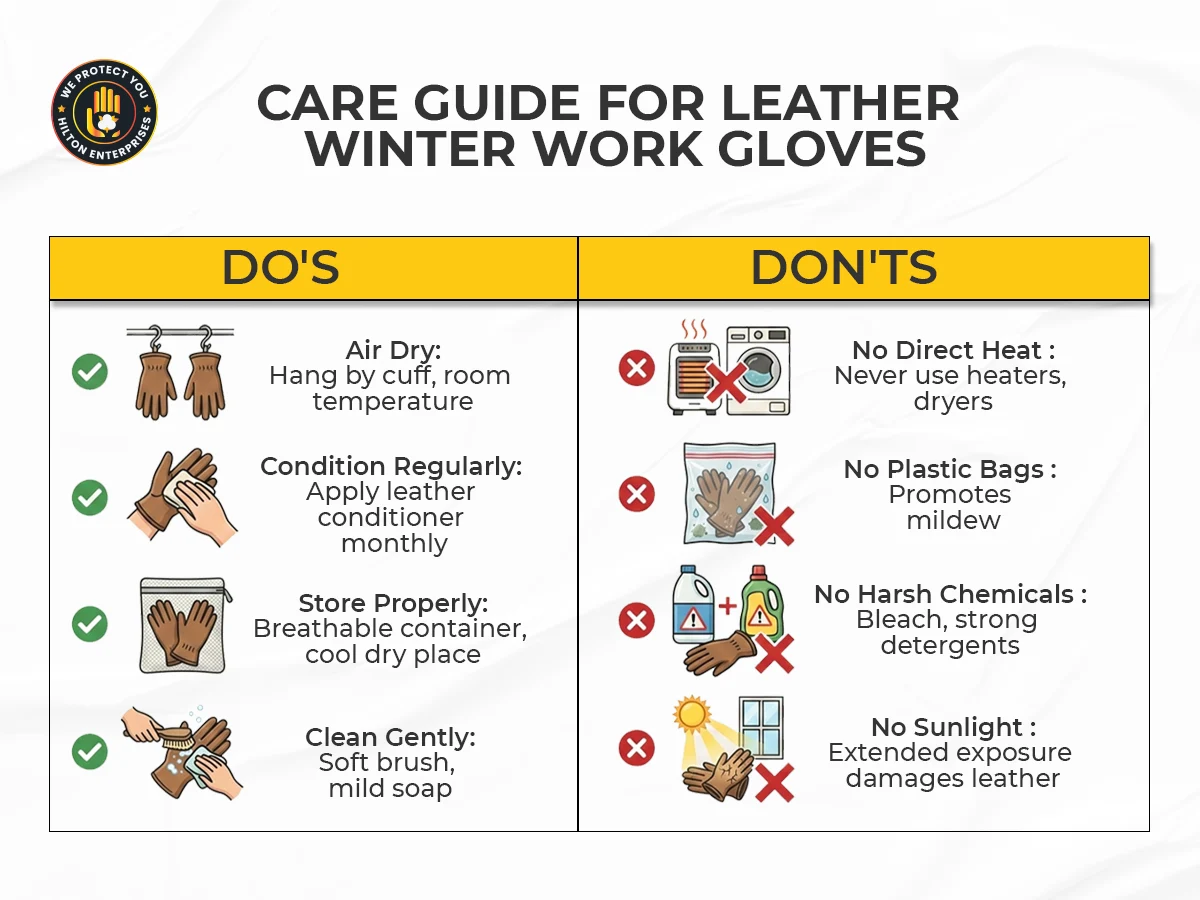
Proper care extends glove life significantly, improving the total cost of ownership and ensuring consistent performance.
Daily Care
After Each Use:
- Remove debris: Brush off dirt, sawdust, or other materials
- Inspect for damage: Check for tears, worn spots, loose stitching
- Air dry if damp: Hang in a well-ventilated area (never use direct heat)
Drying Methods:
DO:
- Room temperature air drying
- Hang by cuff to promote air circulation
- Stuff with newspaper if wet inside
- Rotate positioning to dry evenly
DON’T:
- Direct heat (radiators, heaters, furnaces)
- Direct sunlight for extended periods
- Clothes dryers
- Leaving items in closed lockers while wet
Why Direct Heat Damages Gloves:
Heat breaks down leather fibers, causes stiffening, and damages insulation. Leather dried too quickly becomes brittle and cracks prematurely.
Cleaning Leather Work Gloves
Light Cleaning (Weekly or as needed):
- Brush off surface dirt with a soft brush
- Wipe with a slightly damp cloth
- Air dry completely
- Apply leather conditioner if appearing dry
Deep Cleaning (Monthly for heavy use):
- Mix mild soap with lukewarm water
- Use a soft brush or a cloth to gently clean
- Rinse with clean, damp cloth (remove soap residue)
- Air dry thoroughly (24-48 hours)
- Condition the leather after fully dry
Products to Use:
- Leather-specific cleaners (saddle soap)
- Mild liquid hand soap (emergency substitute)
- Leather conditioner or oil
Products to Avoid:
- Harsh detergents
- Bleach or chlorine products
- Petroleum-based products (unless specified for leather)
Conditioning & Waterproofing
When to Condition:
- Every 2-4 weeks for frequent use
- When leather feels dry or stiff
- After deep cleaning
- Before long-term storage
Conditioning Process:
- Ensure gloves are clean and dry
- Apply thin, even coat of leather conditioner
- Work into leather with circular motions
- Let absorb overnight
- Buff with a soft cloth to remove excess
Waterproofing Treatment:
Leather naturally resists light moisture, but treatment improves performance:
Treatment Options:
- Beeswax-based products: Natural, effective, may darken leather
- Silicone sprays: Easy application, good water resistance
- Oil-based treatments: Deep penetration, excellent protection
Application:
- Clean and dry gloves thoroughly
- Apply treatment according to product instructions
- Allow to dry completely (usually 24 hours)
- Reapply every 4-8 weeks, depending on exposure
Storage
Off-Season Storage:
Proper Storage Method:
- Clean and condition gloves
- Ensure completely dry
- Store in a breathable container (paper bag, cardboard box)
- Add cedar blocks or lavender to deter insects
- Keep in a cool, dry location
- Avoid compression (don’t stack heavy items on top)
Never Store:
- In plastic bags (promotes mildew)
- In damp basements
- In hot attics
- In direct sunlight
When to Replace Winter Work Gloves
Safety-Critical Replacement Indicators:
Replace Immediately If:
- Holes through palm or fingers (cold air entry, reduced protection)
- Insulation compressed flat (no longer provides warmth)
- Seams failing (imminent complete failure)
- Stiffness prevents proper grip (safety hazard)
Plan for Replacement Soon:
- Visible wear on the palm or fingertips
- Reduced water resistance
- Lining pulling away from the outer shell
- Elastic/cuff losing tension
Average Lifespan by Quality:
- Budget gloves ($8-$12): 2-4 months of heavy use
- Mid-range gloves ($12-$20): 4-8 months of heavy use
- Premium gloves ($20-$35): 8-18 months of heavy use
Heavy use defined: 40+ hours/week in demanding conditions
Frequently Asked Questions
Are leather gloves good for winter work?
Yes, leather is excellent for winter work gloves. Quality leather provides natural wind resistance, breathability, and durability superior to most synthetic materials. When lined with proper insulation (Thinsulate, Bio Liner, or fleece), leather winter work gloves offer the best balance of protection, dexterity, and longevity for industrial applications. Full-grain leather performs best, followed by top-grain, with split leather offering budget-friendly protection.
What are the warmest work gloves for extreme cold?
For extreme cold (-20°F and below), gloves with Bio Liner technology or 200g+ Thinsulate insulation provide the best warmth. Refrigiwear’s freezer gloves and specialized arctic work gloves designed for oil field operations offer protection down to -40°F. However, “warmest” isn’t always best; excessive insulation reduces dexterity and may cause overheating during physical work. Match insulation to your actual working temperature for optimal performance.
How do I choose between waterproof and water-resistant winter gloves?
Choose waterproof winter work gloves if you regularly work in:
- Sustained precipitation (rain, sleet, heavy snow)
- Wet materials handling (concrete, wet lumber)
- High-humidity environments (cold storage with condensation)
Choose water-resistant leather gloves for:
- Dry cold conditions
- Occasional light snow exposure
- Situations prioritizing breathability and dexterity
Water-resistant gloves cost $5-$15 less per pair and work well for 80% of winter work scenarios.
What’s better: Thinsulate or fleece-lined gloves?
Choose Thinsulate if you need:
- Maximum dexterity for precision work
- Thin profile for tool operation
- Superior warmth-to-bulk ratio
- Don’t mind paying a 20-30% premium
Choose fleece-lined if you:
- Perform general labor (not precision work)
- Want a softer, more comfortable feel
- Need budget-friendly option ($12-$18 vs $15-$25)
- Can accept slightly more bulk
Bottom line: Thinsulate for mechanics and precision workers; fleece for construction and general labor.
Can I use insulated work gloves for TIG welding?
TIG welding requires thin, supple leather gloves for precise torch control. Use TIG welding gloves with light insulation (40g Thinsulate maximum) made from premium grain leather (often goatskin or top-grain cowhide). Heavy winter insulation impairs the dexterity needed for TIG work. For cold shop conditions, use heated workshops or radiant heaters rather than relying on heavily insulated gloves that compromise weld quality.
How should winter work gloves fit?
Proper fit allows slight room (1/8″ to 1/4″) at fingertips when making a fist. Gloves should be snug without restricting circulation. Test fit by:
- Making a tight fist, no binding or gapping
- Gripping tools with no excess material bunching
- Checking wrist seal, covers the wrist joint without restricting movement
Too tight: Restricts blood flow (makes hands colder) and limits movement
Too loose: Allows cold air entry and reduces dexterity
What’s the difference between 3M Thinsulate and generic “Thinsulate”?
3M Thinsulate™ is a trademarked insulation technology owned by 3M with specific performance standards. Generic “Thinsulate” (lowercase) may be any thin insulation and doesn’t guarantee 3M’s quality standards. Look for “3M Thinsulate” branding on packaging to ensure an authentic product. Genuine 3M Thinsulate offers verified warmth-to-weight ratios, moisture resistance, and durability that generic alternatives may not match.
How do I keep work gloves from getting stiff in cold weather?
Leather stiffens in extreme cold due to moisture freezing in the fibers. Prevent stiffness by:
- Conditioning regularly with leather conditioner (maintains natural oils)
- Storing in a warm area between uses (room temperature)
- Keeping gloves dry (wet leather freezes stiff)
- Warming before use (keep in jacket pockets or warm vehicle)
- Choosing quality leather (full-grain retains flexibility better than split leather)
If gloves become stiff, warm them gradually to room temperature before forcing flexibility.
Do I need different gloves for USA vs Canada winter work?
Both countries have similar cold-weather safety standards, but Canadian provinces often have stricter enforcement and lower temperature thresholds for mandatory protection. Key differences:
- Canada: More prescriptive break requirements in extreme cold
- USA: More employer discretion in cold weather protocols
- Both: Similar ANSI/CSA performance standards for gloves
For actual glove selection, base your choice on working temperature, not location. A construction worker in Minnesota needs similar protection to one in Manitoba if they face the same conditions.
Conclusion: Making the Right Choice for Winter 2026-2027
Selecting the best winter work gloves requires balancing temperature protection, dexterity, durability, and cost. For most workers across the northern United States and Canada, fleece-lined leather work gloves provide excellent value at $12-$18 per pair, offering adequate protection for temperatures from 0°F to 35°F.
Hilton Glove offers competitive pricing on all winter work glove lines, with volume discounts available. Contact us for current pricing tailored to your specific needs.
For precision work requiring maximum dexterity, Thinsulate leather gloves (40-100g) deliver superior warmth without bulk at $15-$25 per pair. Mechanics, electricians, and skilled trades consistently rate Thinsulate as the best option for maintaining tactile sensitivity in cold conditions.
When facing genuinely extreme cold, oil fields, northern utilities, cold storage, or temperatures regularly below -10°F, invest in Bio Liner Cold Resistance technology. At $18-$28 per pair, Bio Liner gloves provide the advanced moisture management and insulation needed for harsh conditions where inadequate gloves create safety risks.
Ready to outfit your team with quality winter work gloves? Browse our complete selection of insulated leather work gloves or contact us for bulk pricing and custom solutions.