


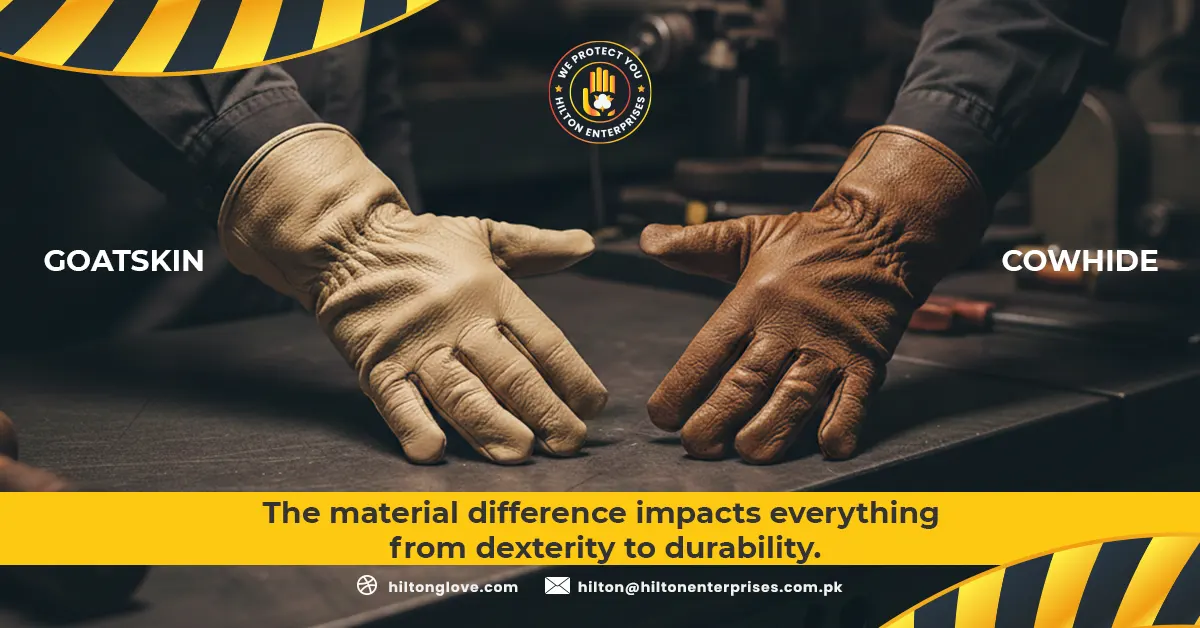
Quick Answer: Choosing between goatskin and cowhide work gloves depends on your specific application. Goatskin excels in precision work requiring exceptional dexterity (like TIG welding and assembly), while cowhide provides superior durability and heat resistance for heavy-duty tasks (like construction and MIG welding). This comprehensive guide will help you make the right choice for your workplace.
When selecting the best leather work gloves for your US or Canadian workforce, the decision often comes down to goatskin vs cowhide work gloves. While both goat skin gloves and cowhide leather work gloves have proven their worth across North American Industries, understanding the performance differences between these materials can significantly impact worker safety, productivity, and your bottom line.
As a leading manufacturer serving North American markets since 1975, we’ve spent decades perfecting both goatskin and cowhide products for applications ranging from precision automotive assembly to demanding construction work across the US and Canada. This guide synthesizes that expertise to help procurement managers, safety coordinators, and workers make informed decisions.
Selecting appropriate hand protection isn’t just about comfort and performance; it’s a regulatory requirement. OSHA’s hand protection guidelines (29 CFR 1910.138) mandate that employers assess workplace hazards and provide suitable gloves. Understanding the goatskin vs cowhide performance differences is essential for OSHA-compliant PPE programs.
📋 Table of Contents
- Quick Comparison: Goatskin vs Cowhide at a Glance
- Material Characteristics: Understanding the Difference
- Performance Breakdown: 6 Critical Factors
- Welding Applications: TIG vs MIG Material Requirements
- Best Leather Work Gloves by Industry
- Understanding Leather Grades: Full Grain Matters
- Cold Weather Performance: Insulated Options
- B2B Procurement: Bulk Purchasing Economics
- Decision Framework: Choosing the Right Material
- Frequently Asked Questions
Quick Comparison: Goatskin vs Cowhide at a Glance
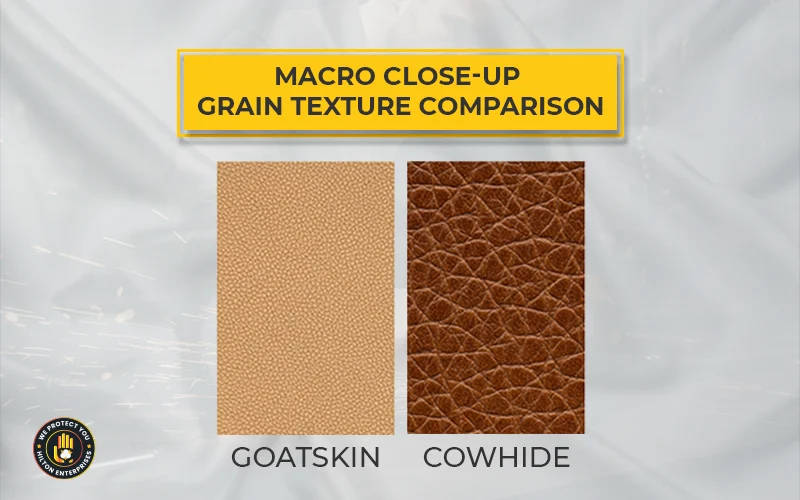
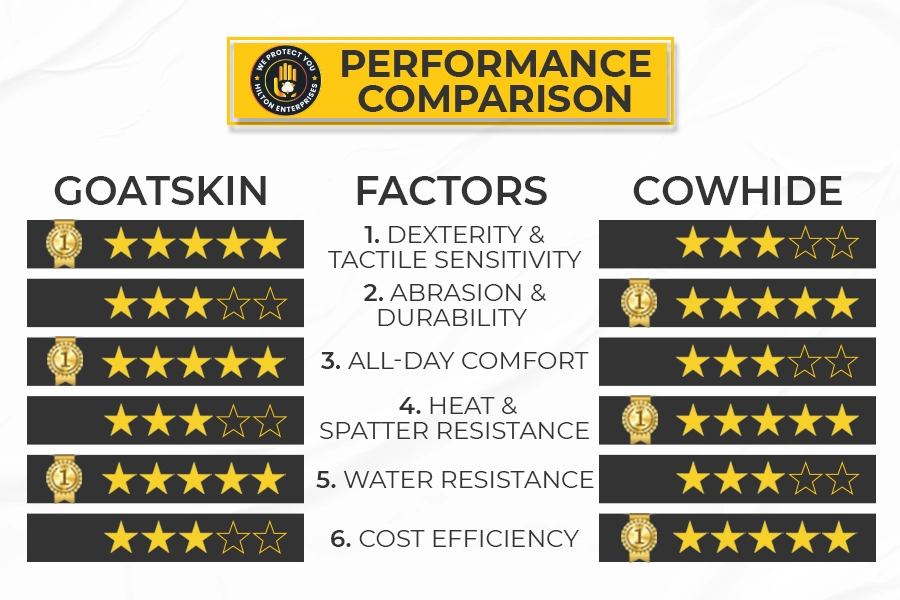
Before diving into the details, here’s a head-to-head comparison of how goatskin and cowhide leather perform across the most important criteria for work gloves:
| Dexterity & Tactile Sensitivity | ★★★★★ Exceptional | ★★★☆☆ Moderate | Goatskin |
| Heavy-Duty Durability | ★★★★☆ Very Good | ★★★★★ Excellent | Cowhide |
| All-Day Comfort | ★★★★★ Superior | ★★★☆☆ Good | Goatskin |
| Water Resistance | ★★★★★ Excellent (lanolin) | ★★★☆☆ Moderate | Goatskin |
| Heat Resistance | ★★★☆☆ Good | ★★★★★ Excellent | Cowhide |
| Abrasion Resistance | ★★★★☆ Very Good | ★★★★★ Outstanding | Cowhide |
| Initial Cost | Higher ($$$) | Lower ($$) | Cowhide |
| Best Applications | TIG welding, assembly, precision work, electronics | MIG welding, construction, general labor, heavy fabrication | Application-dependent |
| Performance Factor | Goatskin Leather | Cowhide Leather | Winner |
For US and Canadian Procurement Managers: This comparison reflects real-world performance data from clients across North American industries, including automotive, construction, manufacturing, and welding operations from Texas to Alberta, Michigan to Ontario.
Material Characteristics: Understanding the Difference Between Goatskin and Cowhide
The fundamental differences between goat leather and cow leather stem from the animals’ natural hide structure, which directly impacts how the finished gloves perform in real-world conditions.
Goatskin Leather Properties: Nature’s Premium Performance Material
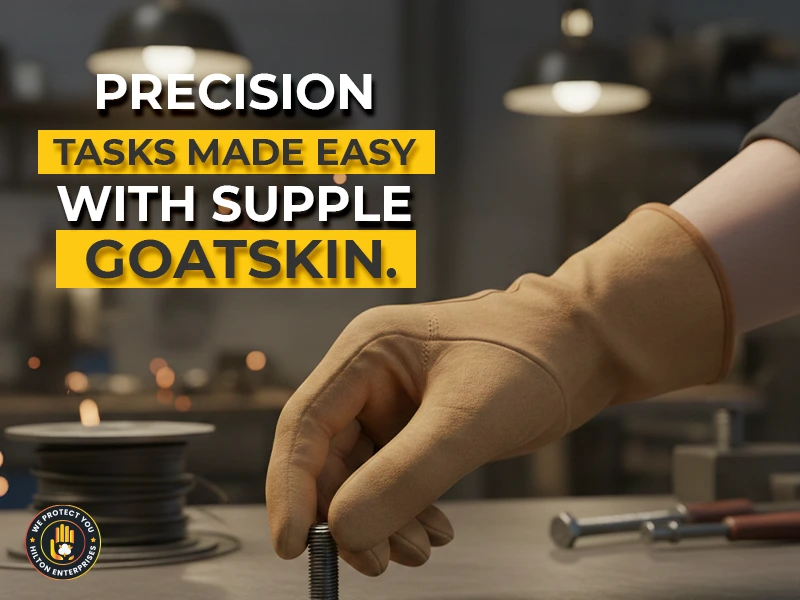
Goatskin leather, used in our premium Goat Skin Gloves with Keystone Thumb, possesses several unique characteristics that make it ideal for precision applications:
🔬 What Makes Goatskin Special:
- Natural Lanolin Content: Goat hides contain higher levels of lanolin, a natural oil that makes the leather inherently water-resistant and keeps it supple even after repeated wet/dry cycles. This means goatskin gloves maintain their flexibility and don’t stiffen like some cowhide options.
- Tighter Grain Structure: The grain pattern on goatskin is naturally finer and more densely packed than cowhide, creating a smoother surface that provides superior tactile sensitivity without sacrificing durability.
- Lightweight Yet Strong: Goat leather achieves impressive tensile strength while remaining thinner and lighter than comparable cowhide. This is why precision workers prefer goatskin for tasks requiring long wear periods.
- Natural Breathability: The microscopic pore structure in goatskin allows better air circulation, reducing hand fatigue and perspiration during extended use, critical for manufacturing operations.
These properties make goatskin the preferred choice for our Grain Leather Assembling Gloves, where workers need to maintain dexterity while handling delicate components for hours at a time.
Cowhide Leather Characteristics: The Workhorse Material
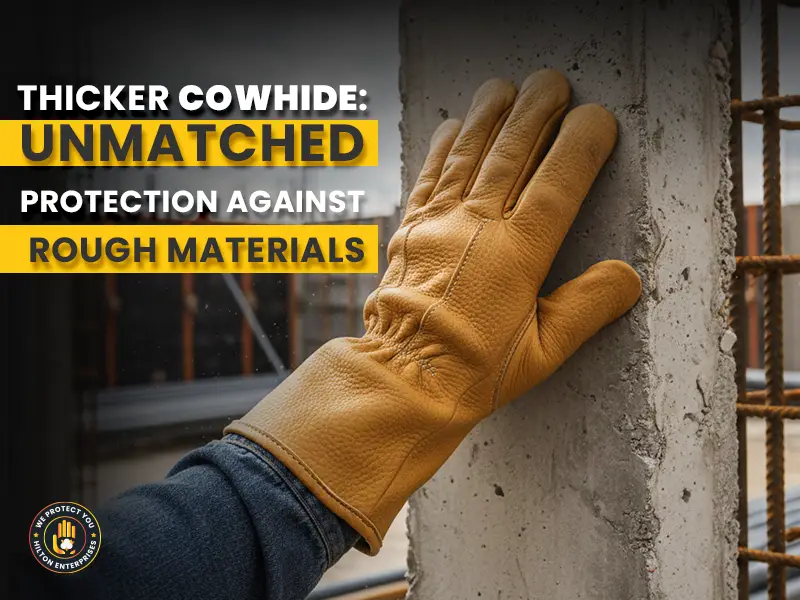
Cowhide leather, featured in products like our Furniture Hide Grain Leather gloves and Welding Gloves with Reinforced Palm, offers different but equally valuable properties:
💪 Cowhide’s Strengths:
- Exceptional Thickness: Cow hides are naturally thicker than goat hides, providing superior protection against punctures, cuts, and abrasion. essential for construction applications.
- Superior Heat Resistance: The denser fiber structure of cowhide can withstand higher temperatures longer, making it ideal for welding operations, particularly MIG welding with piping reinforcement.
- Outstanding Abrasion Resistance: Cowhide’s thicker grain layer resists wearing through better than goatskin when repeatedly dragged across rough surfaces like concrete, steel, or lumber.
- Cost-Effective Durability: Generally 30-40% less expensive than comparable quality goatskin, cowhide provides excellent value for applications where ultimate dexterity isn’t the primary concern.
- Break-In Period: While cowhide starts stiffer than goatskin, it conforms to the wearer’s hand over time, creating a custom fit that many workers appreciate.
Performance Breakdown: 6 Critical Factors Compared
1. Dexterity & Tactile Sensitivity: Where Goatskin Dominates

For tasks requiring precise hand movements and tactile feedback, goatskin leather work gloves are unmatched. The material’s natural suppleness allows workers to:
- Feel the fastener threads and component edges through the glove material
- Operate touchscreens and control panels (when properly designed)
- Handle small parts without the bulkiness that causes drops
- Perform detailed work without removing gloves, maintaining continuous hand protection
This is why our Goat Skin Gloves with Keystone Thumb are the top choice for:
- TIG Welding: Where precise torch control is critical for quality welds
- Electronics Assembly: Handling sensitive components that can’t tolerate thick, clumsy protection
- Automotive Assembly: Installing intricate parts in tight engine compartments
- Quality Inspection: Detecting surface defects and irregularities by touch
Real-World Impact: One Michigan-based automotive assembly plant reported a 23% reduction in dropped parts and assembly errors after switching from standard cowhide to our goatskin assembling gloves for precision tasks.
2. Durability & Abrasion Resistance: Cowhide for Heavy-Duty Applications
When the job involves constant contact with rough surfaces, sharp edges, or heavy materials, cowhide work gloves provide superior longevity. The thicker leather construction resists:
- Concrete and masonry abrasion in construction work
- Metal edge cuts during fabrication and material handling
- Repetitive friction from gripping tools and equipment
- Puncture threats from nails, wire, and sharp debris
Our Furniture Hide Grain Leather gloves, made from premium cowhide, typically last 40-60% longer than goatskin equivalents in heavy-duty environments. For the most demanding applications, our Double Palm Canvas Back cowhide gloves add an extra layer of protection in high-wear areas.
Important Note: While goatskin is very durable for its thickness, it’s not the optimal choice for environments where gloves are constantly dragged across rough surfaces. Save goatskin for precision work; use cowhide where extreme abrasion is expected.
3. Comfort & All-Day Wearability: Goatskin’s Lightweight Advantage
Worker fatigue is a real safety concern. Uncomfortable gloves get removed, defeating their protective purpose. Goatskin’s lighter weight and natural breathability make a significant difference during long shifts:
- 25-35% lighter than equivalent protection level cowhide gloves
- Better moisture management through natural pore structure
- Stays supple longer due to lanolin content
- Less hand fatigue during repetitive tasks
For workers wearing gloves 8+ hours daily in climate-controlled manufacturing environments, this comfort factor often justifies goatskin’s higher initial cost. Our Grain Leather Assembling Gloves exemplify this comfort-first design philosophy.
4. Weather Resistance: Different Strengths for Different Conditions
Water Resistance: Goatskin’s Natural Edge
Goatskin’s higher lanolin content provides inherent water resistance that cowhide lacks. While neither material is truly waterproof, goatskin:
- Repels light moisture and oil spills better
- Maintains flexibility when wet (cowhide can stiffen)
- Dries faster without cracking
- Resists salt and chemical degradation better
Cold Weather Performance: Insulated Options in Both Materials
For workers in northern US states and Canadian provinces where winter temperatures regularly drop below freezing, selecting insulated gloves with the right base material is critical for both warmth and workplace productivity.
For winter work, both materials can be enhanced with insulation. We offer:
- Grain Leather Thinsulate Lined Gloves (goatskin or cowhide options) for sub-freezing conditions
- Bio Liner Cold Resistance Gloves for extreme cold with maximum dexterity
Goatskin insulated gloves maintain better dexterity in cold weather, while cowhide insulated gloves provide superior durability for rough outdoor work. The choice depends on your primary concern: precision vs. protection.
5. Heat Resistance: Critical for Welding Applications
This is where material selection becomes safety-critical. Cowhide’s denser fiber structure withstands direct heat exposure significantly better than goatskin:
| Heat Exposure Type | Goatskin Performance | Cowhide Performance | Recommendation |
|---|---|---|---|
| Radiant Heat (TIG) | Excellent – thinner material dissipates heat | Good – but bulkier | Goatskin TIG gloves |
| Direct Sparks (MIG) | Moderate – can char faster | Excellent – resists burn-through | Cowhide MIG gloves |
| Heavy Spatter (Stick) | Not recommended | Excellent with reinforcement | Reinforced cowhide |
| Incidental Contact | Good for brief contact | Excellent for sustained contact | Depends on frequency |
We’ll explore this critical difference in depth in the welding applications section below.
6. Cost Analysis: Initial Investment vs. Long-Term Value
The price difference between goatskin and cowhide is significant, but the total cost of ownership tells a more nuanced story:
💰 Typical Price Comparison (Per Pair):
- Standard Cowhide Gloves: $8-15
- Premium Grain Cowhide: $12-22
- Standard Goatskin Gloves: $15-28
- Premium Goatskin with Features: $22-38
However, the replacement frequency changes the equation:
- In precision assembly work, goatskin gloves may last 2-3x longer than cheaper alternatives because workers actually wear them (comfort = compliance)
- In heavy abrasion environments, cowhide gloves last longer despite lower initial quality, making them more economical
- Productivity gains from better dexterity often exceed the material cost differential
For bulk procurement guidance, see our B2B purchasing section below.
Welding Applications: Why Material Selection Matters for TIG vs MIG
Welding gloves represent one of the clearest examples of how goatskin vs cowhide material choice directly impacts both safety and work quality. Across fabrication shops, construction sites, and manufacturing facilities throughout the US and Canada, choosing the wrong material for your welding process can mean the difference between efficient, safe work and constant glove replacement. The type of welding process fundamentally determines which leather performs better.
TIG Welding Gloves: Where Goatskin Excels
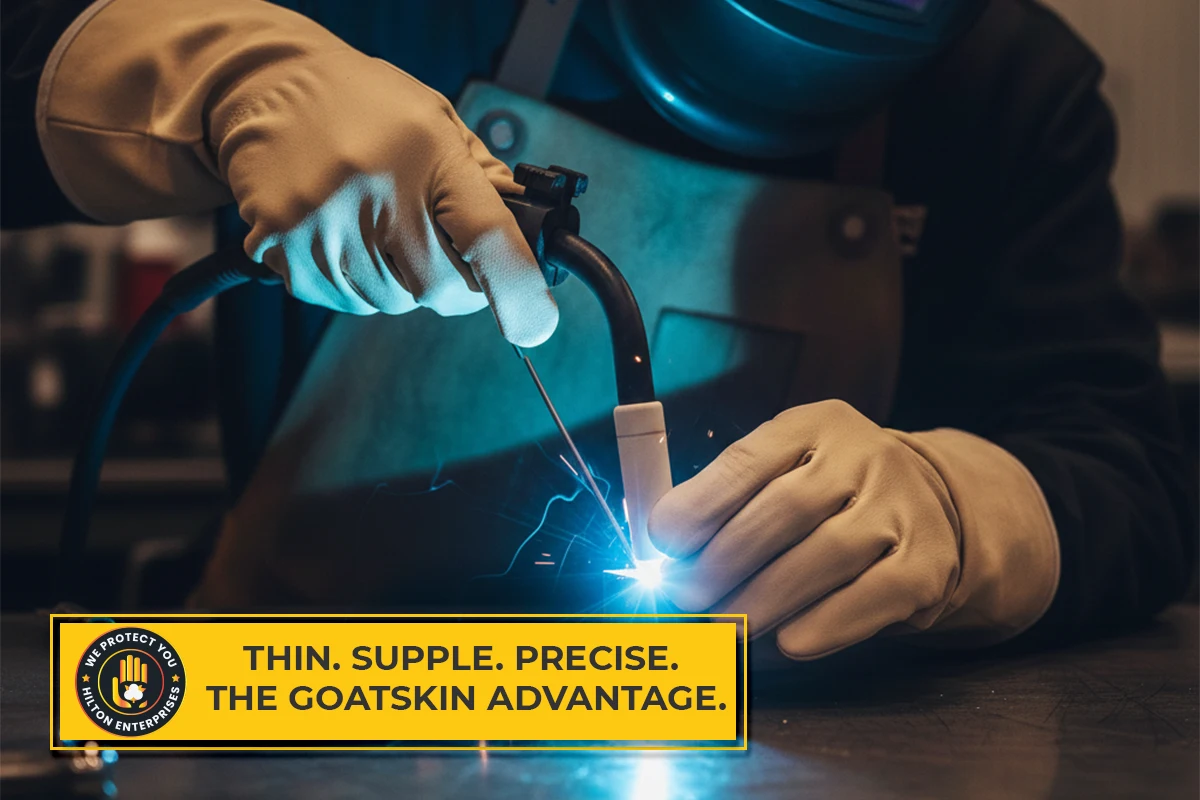
TIG (Tungsten Inert Gas) welding demands exceptional torch control and tactile feedback to produce quality welds. This is why professional TIG welders overwhelmingly prefer goatskin:
⚡ Why Goatskin for TIG Welding:
- Precise Torch Positioning: TIG welding requires holding the torch at exact angles within millimeters. Goatskin’s thinner, more flexible leather allows welders to feel the torch position naturally, reducing arm fatigue during long sessions.
- Filler Rod Control: Feeding filler rod with the non-torch hand demands fingertip sensitivity that thick cowhide simply can’t provide. Our TIG Welding Gloves use premium goatskin palms specifically for this reason.
- Heat Management: TIG produces primarily radiant heat rather than sparks. Goatskin’s thinner profile actually helps here; it doesn’t trap heat like thick cowhide, keeping hands cooler during extended welding sessions.
- Reduced Hand Fatigue: Professional TIG welders often work 6-10-hour days. The lighter weight of goatskin significantly reduces the cumulative fatigue from holding the torch, improving both weld quality and welder endurance.
North American TIG Welding Standards: TIG welding is extensively used in the US and Canadian aerospace, automotive, and precision fabrication industries, where AWS (American Welding Society) standards and CWB (Canadian Welding Bureau) certified work demands the highest quality welds. Goatskin’s superior dexterity helps welders meet these exacting standards consistently. Goatskin’s superior dexterity helps welders meet these exacting North American standards consistently.
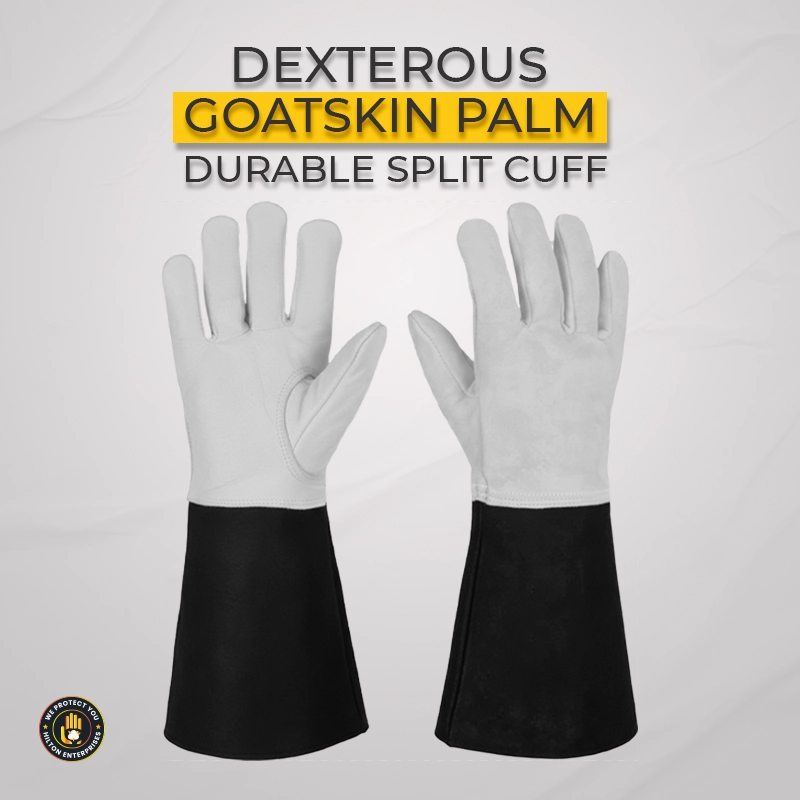
TIG Welding Glove Construction: Our TIG welding gloves typically feature:
- Premium grain goatskin palm and fingers (0.8-1.0mm thickness)
- Split cowhide cuff for spark protection where dexterity isn’t needed
- Kevlar stitching is resistant to burn-through
- Seamless palm construction to prevent pressure points
Important Safety Note: While goatskin excels for TIG, it’s NOT suitable for heavy stick welding or applications with substantial spatter. Always match your glove material to your welding process.
MIG Welding Gloves: Cowhide’s Domain
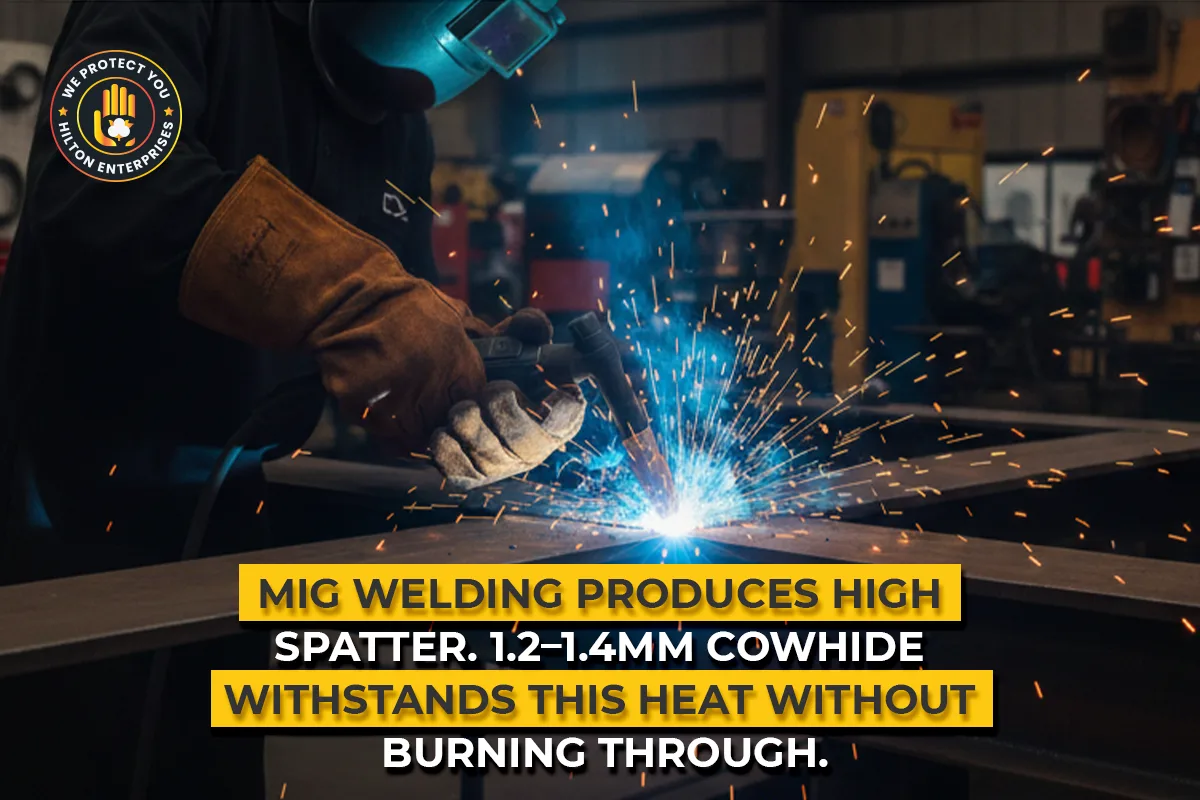
MIG (Metal Inert Gas) welding produces significantly more sparks and spatter than TIG, creating different glove requirements where cowhide’s durability becomes essential:
🔥 Why Cowhide for MIG Welding:
- Spatter Resistance: MIG welding throws hot metal spatter that can quickly burn through thinner goatskin. Cowhide’s 1.2-1.4mm thickness provides the protection needed for all-day MIG work.
- Durability Under Heat: The constant exposure to sparks in MIG welding gradually degrades leather. Cowhide’s denser fiber structure withstands this punishment far longer than goatskin.
- Cost-Effectiveness: Since MIG welding gloves wear out faster due to spatter damage regardless of material, using less expensive cowhide makes economic sense.
- Reinforcement Options: Our Welding Gloves with Piping and Reinforced Palm variants use thick cowhide in critical wear areas, extending glove life in high-spatter environments.
From Texas pipeline welding to Alberta oil & gas fabrication, MIG welding operations across North America demand heavy-duty cowhide protection that can withstand the intense spatter and heat these applications generate day after day.
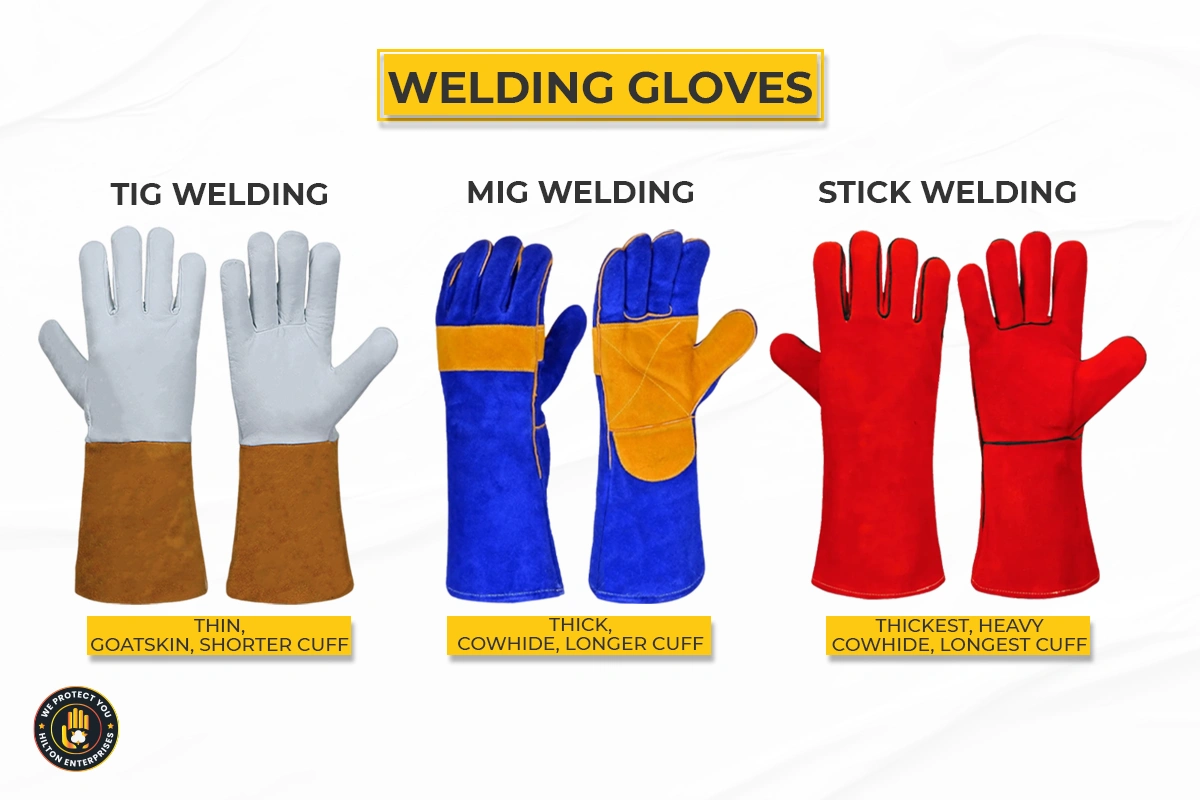
MIG Welding Glove Construction: Our cowhide MIG gloves feature:
- Heavy-duty split or grain cowhide throughout (1.2-1.4mm thick)
- Reinforced palm and thumb areas for extended life
- Extended cuff (14-16 inches) for forearm protection
- Heat-resistant Kevlar stitching throughout
- Sometimes, cotton or canvas backing for insulation
Stick Welding (SMAW): Heavy-Duty Cowhide Essential
Stick welding (Shielded Metal Arc Welding) produces the most spatter and requires the heaviest protection. Only our reinforced cowhide options, like the Welding Gloves with Reinforced Palm provide adequate protection for this demanding process.
| Welding Process | Recommended Material | Key Features Needed | Our Product |
|---|---|---|---|
| TIG (GTAW) | Goatskin | Maximum dexterity, tactile sensitivity, moderate heat resistance | TIG Welding Gloves |
| MIG (GMAW) | Cowhide | Spatter resistance, good heat protection, and durability | Welding Gloves with Piping |
| Stick (SMAW) | Heavy Cowhide | Maximum spatter protection, reinforced palm, extended cuff | Reinforced Palm Welding |
| Oxy-Fuel | Medium Cowhide | Heat resistance, dexterity for torch valves | Standard MIG Gloves |
Pro Tip: Many professional welding shops keep both goatskin TIG gloves and cowhide MIG/Stick gloves in stock, selecting based on the day’s work. This dual-material approach optimizes both safety and productivity.
Best Leather Work Gloves by Industry Application
Beyond welding, different industries have unique requirements that favor either goatskin or cowhide. Here’s our application-specific guidance based on decades of working with clients across sectors:
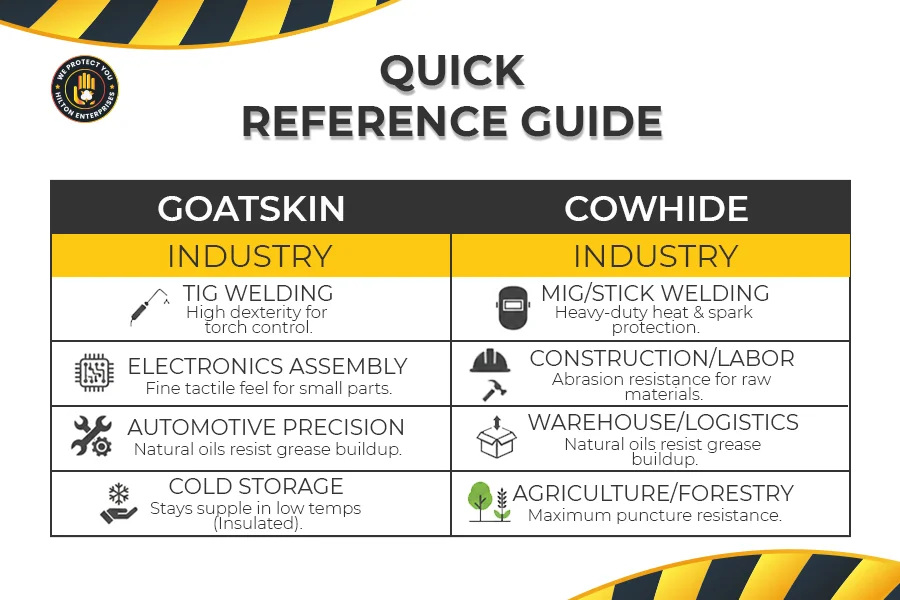
Precision Manufacturing & Electronics Assembly
Recommended Material: Goatskin
Workers assembling electronics, medical devices, aerospace components, or other precision products need maximum dexterity without sacrificing hand protection from sharp edges and chemical exposure. Our Grain Leather Assembling Gloves excel here because:
- Workers can feel component alignment through the glove material
- Thin profile prevents dropped parts (costly in precision assembly)
- Smooth goatskin doesn’t snag on delicate wiring or components
- All-day comfort means consistent glove usage (compliance = safety)
Case Study: An electronics manufacturer reduced assembly defects by 31% and component drops by 47% after switching from general-purpose cowhide to our goatskin assembling gloves. The improved tactile feedback allowed workers to detect misaligned parts before forcing assembly.
Construction & General Labor
Recommended Material: Cowhide

US and Canadian construction sites – from high-rise projects in Toronto to highway infrastructure in California- demand gloves that can survive constant abuse from rough materials, sharp edges, and heavy equipment. Our construction-specific cowhide gloves provide:
- Excellent abrasion resistance against concrete, lumber, and steel
- Puncture protection from nails, screws, and wire
- Economical replacement cost for this high-wear environment
- Available with canvas backing for breathability or double palm for extreme durability
For high-visibility requirements, our Hi-Vis Split Leather gloves combine cowhide’s durability with ANSI-compliant visibility.
Automotive Repair & Maintenance
Recommended Material: Application-Dependent (Hybrid Approach Often Best)
Automotive work spans from delicate sensor installation to heavy impact work, making material selection complex:
- For engine assembly and electrical work, Goatskin gloves provide the dexterity needed in tight engine compartments
- For brake work and suspension: Cowhide grain leather offers protection from sharp metal edges and hydraulic fluids
- For general mechanics: Our Premium TPR Safety Gloves combine leather palms with impact protection for versatility
North America’s automotive industry, spanning from Detroit’s automotive manufacturing hub to Ontario’s automotive corridor, represents one of the largest markets for precision work gloves, where the goatskin vs cowhide decision directly impacts assembly efficiency.
Many professional automotive technicians keep both materials available, selecting based on the specific repair task.
Material Handling & Warehousing
Recommended Material: Cowhide
Workers moving boxes, pallets, and equipment all day need gloves that can withstand constant friction and occasional impacts. Cowhide provides:
- Extended wear life despite continuous use
- Good grip on various surfaces
- Protection from cardboard cuts and pallet splinters
- Cost-effective protection for high-volume glove usage
Our warehouse-specific gloves often feature cowhide palms with breathable canvas backs to manage perspiration during physically demanding work.
Agriculture & Forestry
Recommended Material: Cowhide (with water resistance considerations)
Agricultural and forestry work involves exposure to moisture, rough materials, and occasional chemical contact. Premium cowhide with treatments for water resistance offers the best balance of protection and durability for:
- Equipment operation and maintenance
- Fence repair and installation
- Livestock handling
- Timber and firewood processing
Check our agriculture glove collection and forestry-specific options for treated cowhide that maintains performance in wet conditions.
Oil & Gas / Heavy Industry
Recommended Material: Reinforced Cowhide or Hybrid
US Gulf Coast refineries, Alberta oil sands operations, and petrochemical facilities across North America present multiple hazards requiring specialized protection:
- For general rig work: Heavy-duty cowhide with reinforced palms
- For valve operation and instrumentation: Grain leather with insulation for cold climates
- For maintenance tasks requiring impact protection: TPR-enhanced leather gloves
Our heavy-duty glove line features reinforced cowhide designed specifically for these demanding applications.
Understanding Leather Grades: Why Full Grain Matters for Both Materials
Whether you choose goatskin or cowhide, the quality grade of the leather significantly impacts performance, durability, and value. Many buyers don’t realize that “leather” isn’t a uniform material; the grade determines everything.
The Leather Quality Hierarchy
Both goat and cow hides are processed into different quality grades, each with distinct characteristics:
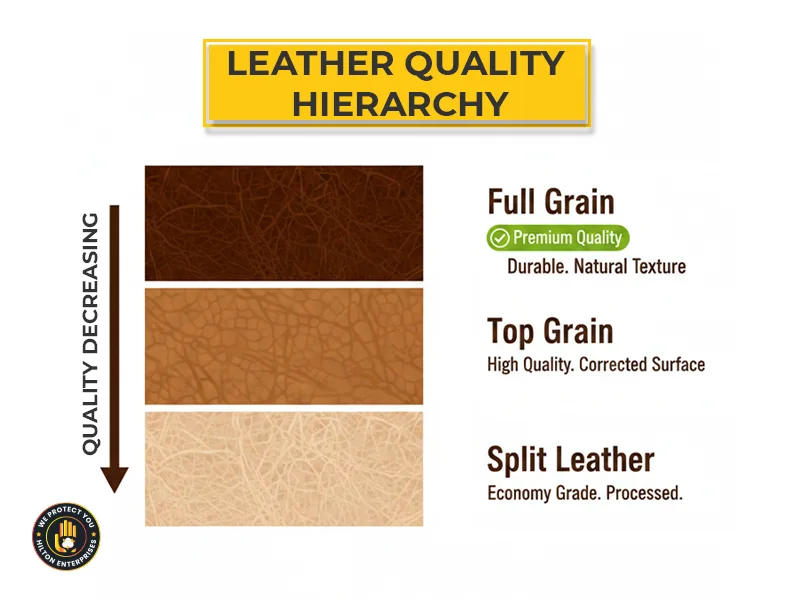
🏆 Leather Quality Levels (Best to Lowest):
1. Full Grain Leather (Premium Quality)
- Includes the entire grain surface with natural texture intact
- Most durable and breathable option
- Develops an attractive patina over time
- Most expensive but longest-lasting
- Used in our premium lines like Goat Skin Gloves and Furniture Hide Grain
2. Top Grain Leather (High Quality)
- Outer layer of hide with slight buffing to remove imperfections
- More uniform appearance than full grain
- Still very durable and breathable
- Good balance of quality and cost
- Common in quality work gloves
3. Split Leather (Economy Grade)
- Inner layers of hide after the top grain is removed
- Lacks the natural grain surface
- Less breathable and durable than grain leather
- Often treated with coatings to improve appearance
- Appropriate for specific applications like our Hi-Vis Split Leather where visibility and cost matter more than premium durability
Our leather work gloves are manufactured to meet or exceed ANSI/ISEA 105 hand protection standards for cut resistance, abrasion, and puncture protection, the benchmark used by US safety managers for PPE procurement decisions.
Full Grain Goatskin vs Full Grain Cowhide
When comparing premium materials (full grain to full grain), the inherent differences between goat and cow hides become most apparent:
| Characteristic | Full Grain Goatskin | Full Grain Cowhide |
|---|---|---|
| Grain Pattern | Fine, tight, pebbled texture | Larger, more pronounced grain |
| Tensile Strength | Very high for thickness (8,000-12,000 PSI) | Excellent overall (6,000-10,000 PSI but thicker) |
| Breathability | Superior (natural pore structure) | Good (denser but still breathable) |
| Break-In Period | Minimal – supple from first use | Moderate – conforms to hand over time |
| Aging Characteristics | Develops rich patina, stays supple | Becomes more comfortable, can darken |
| Typical Thickness | 0.6-1.0mm for work gloves | 1.0-1.4mm for work gloves |
How to Identify Quality Leather in Work Gloves
When evaluating work glove quality, look for these indicators of premium leather:
- Natural grain visible: You should see the natural texture of the animal hide, not a uniform, painted-looking surface
- Consistent thickness: Quality leather has even thickness throughout (cheap split leather often varies)
- Natural color variations: Premium grain leather shows slight color variation, perfectly uniform color suggests heavy coating
- Flexibility test: Grain leather should bend easily without white stress marks appearing
- Smell: Natural leather has a distinctive, pleasant smell; heavily treated or synthetic materials smell chemical
Buyer Beware: Some manufacturers label split leather as simply “leather” without disclosing the quality level. Always ask specifically for “full grain” or “top grain” if you want premium quality. Our product descriptions clearly specify the leather grade used in each glove model.
Understanding Leather Grades for US/Canadian Procurement: When sourcing leather work gloves for North American operations, always verify the grade with your supplier. Some overseas manufacturers label split leather simply as “leather” without disclosure, a practice that doesn’t meet the transparency standards expected by US and Canadian safety managers.
Cold Weather Performance: Insulated Goatskin vs Cowhide Options
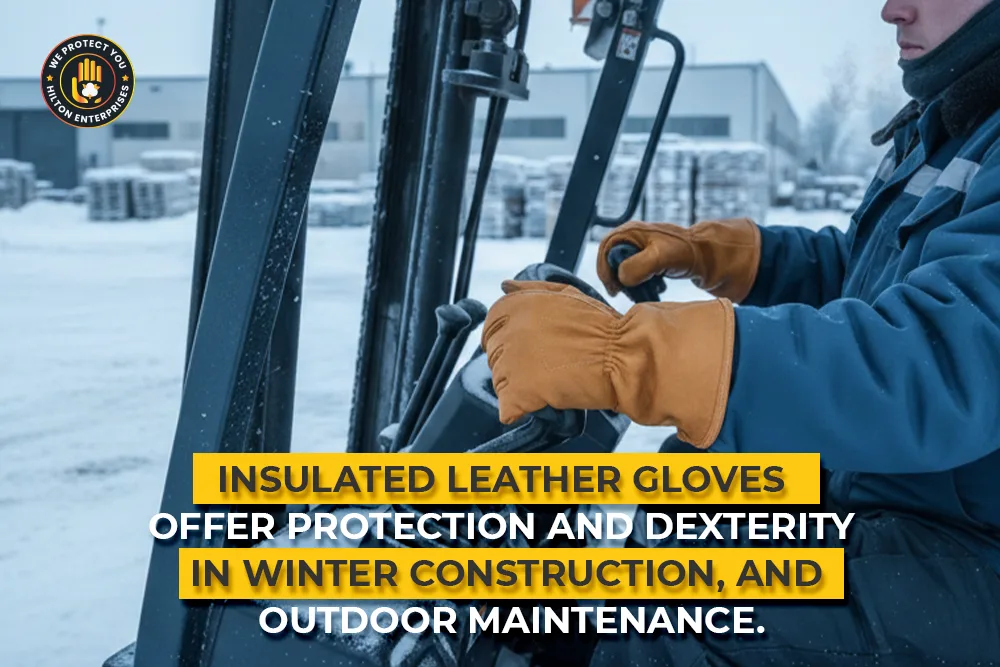
When temperatures drop across northern US states and throughout Canada, where winter work is a reality for construction, utilities, transportation, and outdoor maintenance crews, workers still need hand protection that allows them to perform their jobs safely and efficiently.
The choice between insulated goatskin and cowhide gloves depends on the balance required between warmth, dexterity, and durability in cold conditions.
How Cold Affects Different Leather Types
Both goatskin and cowhide respond differently to cold temperatures:
❄️ Goatskin in Cold Weather:
- Maintains flexibility: Natural lanolin prevents stiffening that affects many materials in cold weather
- Better tactile sensitivity when cold: Thinner material means less numbness when temperatures drop
- Faster warm-up time: Your hand heat warms goatskin gloves more quickly than thick cowhide
- Moisture resistance: Lanolin helps shed light snow and ice without absorbing moisture
❄️ Cowhide in Cold Weather:
- Superior wind protection: Denser, thicker leather blocks wind better
- Better cut/abrasion protection: Cold doesn’t reduce cowhide’s protective qualities
- More insulation space: Thicker leather allows for more robust insulation systems
- Better for wet/slushy conditions: When properly treated, cowhide’s thickness provides more protection
Our Premium Cold-Weather Leather Glove Options
Grain Leather Thinsulate Lined Gloves (Goatskin or Cowhide Options)
Our Grain Leather Thinsulate Lined Gloves are available in both materials, allowing you to choose based on your priority:
- Goatskin version: Best for precision work in cold environments (winter assembly, cold storage picking, utility maintenance)
- Cowhide version: Better for outdoor construction, cold weather driving, winter landscaping
- Both feature: 3M Thinsulate insulation (40g or 100g options), fleece lining, and elastic or knit wrist cuffs
Bio Liner Cold Resistance Gloves
For extreme cold conditions requiring maximum warmth with reasonable dexterity, our Bio Liner Cold Resistance Gloves feature:
- Advanced synthetic insulation that works when wet
- Available with goatskin or cowhide outer shell
- Rated for temperatures down to -20°F (-29°C)
- Moisture-wicking liner keeps hands dry
Winter Tactical Gloves
For law enforcement, security, or outdoor tactical applications, our Winter Tactical Gloves combine goatskin palms for trigger sensitivity with cowhide knuckle protection and weatherproof backing.
Cold Weather Application Guide
| Application | Temperature Range | Recommended Material | Product Link |
|---|---|---|---|
| Cold storage warehouse work | 0°F to 40°F | Insulated Goatskin | Thinsulate Goatskin |
| Winter construction | 20°F to 50°F | Insulated Cowhide | Thinsulate Cowhide |
| Outdoor utility maintenance | 10°F to 45°F | Lined Goatskin (dexterity priority) | Thinsulate Goatskin |
| Extreme cold exposure | Below 0°F | Heavy insulated Cowhide | Bio Liner Cold Resistance |
| Winter driving (commercial) | 0°F to 40°F | Lined Goatskin (steering feel) | Thinsulate Goatskin |
Pro Tip: For winter work requiring both warmth and dexterity, consider a layering approach: thin goatskin glove liners under heavier cowhide outer gloves. This lets workers remove the outer layer for precision tasks while maintaining base hand protection.
B2B Procurement Guide: Bulk Purchasing Economics for Goatskin vs Cowhide
For US and Canadian businesses purchasing work gloves in volume, the material choice significantly impacts both upfront costs and total cost of ownership. Whether you’re sourcing for a single facility in Ohio or a multi-site operation spanning from British Columbia to Florida, understanding the economics of goatskin vs cowhide is essential for effective procurement.
This section helps procurement managers make data-driven decisions about bulk leather glove purchases.
Understanding Total Cost of Ownership (TCO)
The purchase price per pair is just one factor in the real cost of hand protection. A comprehensive TCO analysis considers:
💼 Total Cost Components:
- Initial purchase price per pair (varies by material, quality, and volume)
- Average replacement frequency (how long gloves last in your application)
- Compliance rate (do workers actually wear the gloves?)
- Productivity impact (do better gloves improve work speed/quality?)
- Injury costs avoided (workers’ comp claims, lost time, replacement labor)
- Disposal/replacement labor (time spent managing inventory and distribution)
Regional Cost Considerations for North American Buyers: Labor costs, replacement logistics, and downtime expenses vary significantly across the US and Canada. A manufacturing facility in the Greater Toronto Area, paying CAD $28-35/hour for assembly workers, calculates a different ROI on premium goatskin gloves than a Texas warehouse paying USD $16-22/hour. Our procurement team can help you calculate region-specific TCO based on your actual labor costs.
Cost Comparison: Goatskin vs Cowhide in Different Applications
Here’s a real-world TCO analysis for a 50-person workforce over one year:
| Application Scenario | Goatskin Annual Cost | Cowhide Annual Cost | TCO Winner |
|---|---|---|---|
| Precision Assembly (High dexterity needed) 50 workers, 8hr shifts, low abrasion |
$4,500 (2 pairs/worker/year) High compliance (95%) Lower defect rate |
$3,200 (3 pairs/worker/year) Low compliance (65%) Higher defect costs: +$2,800 |
Goatskin ($4,500 vs $6,000 effective) |
| General Construction (Heavy abrasion) 50 workers, variable shifts, rough surfaces |
$9,800 (6 pairs/worker/year) Moderate compliance (75%) |
$4,800 (4 pairs/worker/year) High compliance (92%) |
Cowhide ($4,800 vs $9,800) |
| MIG Welding Shop 30 welders, 10hr shifts, high heat |
$8,100 (9 pairs/welder/year) Low compliance (burn-through issues) |
$4,500 (5 pairs/welder/year) High compliance (90%) |
Cowhide ($4,500 vs $8,100) |
| TIG Welding Specialists 20 welders, precision work, moderate heat |
$5,200 (3 pairs/welder/year) Excellent compliance (98%) Better weld quality |
$3,600 (3 pairs/welder/year) Poor compliance (hand fatigue) Weld rework: +$3,200 |
Goatskin ($5,200 vs $6,800 effective) |
| Mixed Manufacturing 100 workers, various tasks |
Variable by department | Variable by department | Hybrid approach (task-specific) |
Volume Discount Structures
As an ISO-certified manufacturer, we offer tiered pricing for bulk orders. Here’s our typical volume discount structure:
📦 Bulk Pricing Tiers:
- 1-99 pairs: Standard retail pricing
- 100-499 pairs: 15-20% discount (minimum order for bulk pricing)
- 500-999 pairs: 25-30% discount
- 1,000-4,999 pairs: 30-35% discount
- 5,000+ pairs: 35-40% discount + custom manufacturing options
Note: Exact discounts vary by product line and material. Contact our B2B sales team for custom quotes.
Replacement Frequency by Application
Understanding how long gloves last in your specific application is critical for accurate TCO calculations:
| Work Environment | Goatskin Avg. Life | Cowhide Avg. Life | Notes |
|---|---|---|---|
| Electronics assembly (light duty) | 4-6 months | 3-5 months | Goatskin’s comfort drives longer use |
| Automotive assembly (medium duty) | 2-4 months | 2-4 months | Similar lifespan, goatskin offers better dexterity |
| General construction (heavy abrasion) | 3-6 weeks | 6-12 weeks | Cowhide significantly outlasts goatskin |
| Concrete/masonry work (extreme abrasion) | 2-4 weeks | 4-8 weeks | Cowhide essential; goatskin inappropriate |
| TIG welding (precision + moderate heat) | 2-3 months | 3-4 months (if used) | Goatskin preferred despite slightly shorter life |
| MIG welding (heavy spatter) | 3-6 weeks | 6-10 weeks | Goatskin burns through too quickly |
| Warehouse/logistics (constant use) | 2-3 months | 3-5 months | Cowhide more economical |
Bulk Order Recommendations by Company Size
🏢 Small Operations (10-50 employees):
- Start with a 100-pair minimum order for bulk pricing
- Consider mixed order (both materials) to test worker preferences
- Calculate 3-4 pairs per worker per year as baseline
- Use our samples program to test before committing to a bulk purchase
🏭 Medium Operations (50-250 employees):
- 500-1,000 pair orders optimize price vs inventory carrying costs
- Segment by department: precision work gets goatskin, heavy duty gets cowhide
- Establish quarterly or bi-annual reorder schedule
- Request custom sizing distribution based on workforce demographics
- Schedule a consultation with our B2B team for custom procurement planning
🏗️ Large Operations (250+ employees):
- Consider annual contracts for 5,000+ pairs with staged delivery
- Qualify for custom manufacturing (private labeling, custom designs)
- Implement a vending machine or automated dispensing for inventory control
- Request dedicated account management and on-site usage audits
- Negotiate payment terms (Net 30, Net 60, consignment options)
Cross-Border Logistics: Serving US & Canadian Customers
We maintain distribution relationships and customs expertise to serve both US and Canadian customers efficiently:
- For US customers: Direct shipping from our distribution partners with standard ground transit times. All pricing in USD.
- For Canadian customers: We handle customs documentation and can provide landed cost quotes in CAD. Familiar with Canadian compliance requirements, including proper HS classification for duty-free import under CUSMA/USMCA trade agreements where applicable.
- For companies with cross-border operations: Unified pricing and delivery coordination for businesses with facilities in both countries.
Our team understands the unique challenges of sourcing safety equipment across the US-Canada border and can streamline your procurement process.
Quality Assurance for Bulk Orders
When ordering large quantities, quality consistency is critical. Our manufacturing quality controls include:
- ISO 9001: 2015 certified production processes ensuring every pair meets specifications and complies with US and Canadian workplace safety standards
- Batch testing: Random sampling from each production run for tensile strength, seam strength, and dimensional accuracy
- Leather grade verification: We guarantee full grain or top grain as specified (no substitution with lower grades)
- Consistent sizing: Automated cutting systems ensure size consistency across the entire order
- Quality documentation: Available upon request for compliance audits
- North American Compliance: Our gloves meet ANSI/ISEA standards widely specified by US safety managers, and we provide documentation for Canadian CCOHS compliance when required.
For more information about our certifications and quality standards, visit our certifications page.
Ready to Optimize Your Glove Procurement?
Our B2B team helps companies select the right material mix, calculate accurate TCO, and structure volume orders for maximum value.
Request Bulk Quote
Order Free Samples
Decision Framework: Choosing Between Goatskin and Cowhide Work Gloves
After examining all the performance factors, applications, and cost considerations relevant to North American workplace conditions, use this practical decision framework to select the right material for your specific needs:
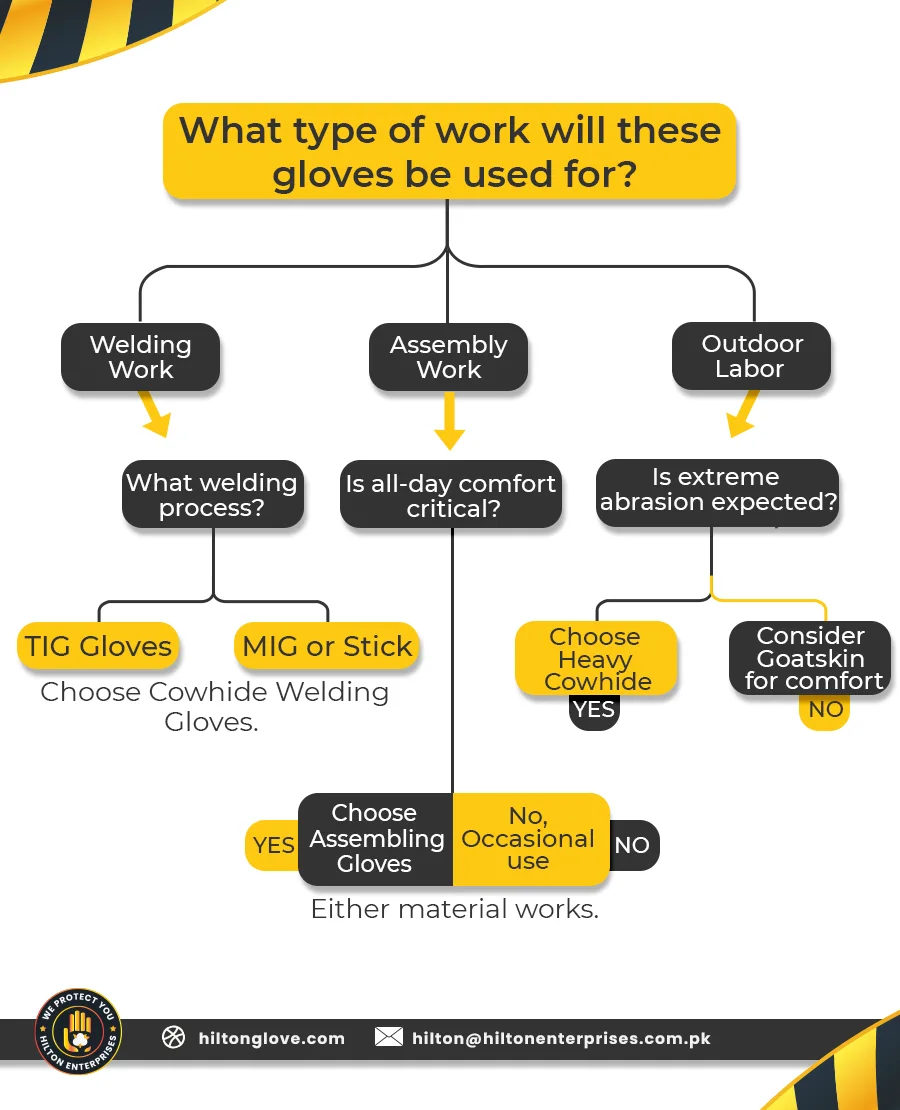
5 Key Questions to Determine the Best Material
1. What is the primary hazard your workers face?
- Sharp objects, punctures, heavy abrasion → Cowhide
- Light cuts, chemical splash, general protection → Either material works
- Heat/sparks (MIG/Stick welding) → Cowhide (reinforced)
- Precision heat work (TIG welding) → Goatskin
- Impact hazards → Consider our TPR-enhanced options
2. How critical is dexterity to job performance?
- Extremely critical (assembly, electrical, TIG welding) → Goatskin
- Moderately important (automotive repair, maintenance) → Goatskin or hybrid
- Less important (material handling, construction) → Cowhide
- Not a priority (heavy equipment operation) → Cowhide
3. What is your expected glove replacement frequency?
- Weekly replacement due to extreme wear → Cowhide (lower cost per pair)
- Monthly replacement (moderate wear) → Calculate TCO for both options
- Quarterly replacement (light duty) → Goatskin (comfort drives compliance)
- Don’t know → Start with our sample program to test both
4. What is your budget constraint?
- Very tight budget, high volume usage → Cowhide (especially canvas back styles)
- Moderate budget, quality matters → Top grain cowhide or standard goatskin
- Premium budget, performance priority → Full grain goatskin
- Mixed needs → Use both materials task-appropriately
5. What are your environmental conditions?
- Cold weather (below 40°F) → Insulated goatskin for dexterity OR insulated cowhide for warmth
- Wet/oily conditions → Goatskin (natural lanolin water resistance)
- Hot/dry conditions → Goatskin (breathability) or cowhide with canvas backing
- Outdoor/variable weather → Cowhide (overall durability)
Quick Reference Decision Matrix
| If Your Priority Is… | Choose This Material | Recommended Product |
|---|---|---|
| Maximum dexterity | Goatskin | Goat Skin Gloves (Keystone Thumb) |
| Heavy-duty durability | Cowhide | Double Palm Canvas Back |
| TIG welding performance | Goatskin | TIG Welding Gloves |
| MIG/Stick welding protection | Cowhide | Reinforced Palm Welding |
| All-day comfort | Goatskin | Grain Leather Assembling |
| Lowest total cost (heavy use) | Cowhide | Furniture Hide Grain |
| Cold weather dexterity | Insulated Goatskin | Thinsulate Lined |
| Extreme cold protection | Insulated Cowhide | Bio Liner Cold Resistance |
| Water resistance | Goatskin | Goat Skin Gloves |
| Construction/General labor | Cowhide | Construction Gloves |
When to Use Both Materials (Hybrid Approach)
Many organizations find that a mixed approach optimizes both performance and cost. Consider maintaining inventory of both materials if you have:
- Multiple departments with different needs (precision manufacturing + shipping/receiving)
- Varied tasks within the same role (mechanics doing both engine assembly and brake work)
- Different skill levels (experienced workers prefer the dexterity of goatskin; new workers need the protection of cowhide)
- Seasonal variation (summer construction in cowhide; winter with insulated goatskin for dexterity)
Browse our comprehensive leather glove collection to compare all available options side by side.
Frequently Asked Questions: Goatskin vs Cowhide Work Gloves
Is goatskin more durable than cowhide for work gloves?
Not necessarily. While goatskin has excellent tensile strength for its thickness, cowhide is generally more durable in heavy abrasion environments. Goatskin excels in applications where flexibility and dexterity matter most (like TIG welding or assembly work), while cowhide outlasts goatskin when constantly exposed to rough surfaces, sharp edges, or heavy materials (like construction work). The “most durable” material depends entirely on your specific application.
Why are goatskin gloves more expensive than cowhide?
Several factors contribute to goatskin’s higher price: (1) goat hides are smaller than cow hides, yielding fewer gloves per hide, (2) the premium qualities of goatskin (lanolin content, fine grain structure) command higher raw material costs, (3) processing goatskin to maintain its natural suppleness requires more careful tanning, and (4) demand for premium goatskin often exceeds supply. However, the cost per hour of use can actually favor goatskin in applications where its superior comfort increases worker compliance and reduces hand fatigue-related errors.
What are the best leather work gloves for construction?
For general construction work, cowhide leather work gloves are the best choice due to their superior abrasion resistance, puncture protection, and cost-effectiveness. Specifically, we recommend our Furniture Hide Grain Leather gloves for quality and durability, or our Double Palm Canvas Back gloves for maximum protection in high-wear areas. For visibility requirements, our Hi-Vis Split Leather gloves combine cowhide durability with ANSI-compliant high-visibility features.
Can I use cowhide gloves for TIG welding?
While you can physically use cowhide gloves for TIG welding, it’s not recommended. TIG welding requires precise torch control and filler rod manipulation that cowhide’s thicker, stiffer leather makes difficult. The bulkiness reduces tactile sensitivity, leading to poor weld quality and increased hand fatigue. Professional TIG welders overwhelmingly prefer goatskin TIG gloves because the thinner, more supple leather allows the precise touch control necessary for quality TIG work. Save cowhide for MIG welding and other higher-spatter processes.
Are goatskin gloves good for welding?
Yes, but specifically for TIG welding. Goatskin gloves are excellent for TIG (Tungsten Inert Gas) welding because they provide the dexterity needed for precise torch control while offering adequate protection against the primarily radiant heat of TIG processes. However, goatskin is NOT recommended for MIG or stick welding, where heavy spatter can quickly burn through the thinner leather. For those applications, use our reinforced cowhide welding gloves instead. Match your glove material to your specific welding process for optimal safety and performance.
Which leather is best for precision work requiring dexterity?
Goatskin is definitely the best leather for precision work requiring high dexterity. Its natural suppleness, thinner profile (without sacrificing strength), and superior tactile sensitivity make it ideal for tasks like electronics assembly, automotive precision work, quality inspection, and TIG welding. Our Grain Leather Assembling Gloves and Goat Skin Gloves with Keystone Thumb are specifically designed for applications where workers need to feel what they’re handling through the glove material.
Do goatskin or cowhide gloves work better in cold weather?
The material properties remain the same across North America, but regional considerations do matter. Canadian operations often prioritize cold-weather performance (insulated options), while southern US facilities focus more on breathability and heat management. Oil & gas operations in Alberta and the US Gulf Coast have similar needs for heavy-duty cowhide protection. The biggest difference is the regulatory framework – Canadian operations may need to verify compliance with Canadian CCOHS guidelines, while US operations typically reference ANSI/ISEA standards. Both materials meet requirements in both countries, but documentation needs may differ. Our team provides the appropriate compliance documentation for either US or Canadian customers.
Do goatskin or cowhide gloves work better in cold weather?
Both materials can work well in cold weather when properly insulated, but they have different strengths. Goatskin maintains better flexibility in cold temperatures due to its natural lanolin content, making insulated goatskin gloves (like our Grain Leather Thinsulate Lined options) ideal for cold weather precision work. Cowhide provides better wind protection and can accommodate heavier insulation for extreme cold, making it better for outdoor labor. For the coldest conditions with maximum warmth needs, our Bio Liner Cold Resistance Gloves are available in both materials.
How do I determine the right glove material for my employees?
Start by analyzing your specific workplace hazards and job requirements using our decision framework above. Consider: (1) the primary hazard (cuts, abrasion, heat, chemicals), (2) dexterity requirements for the job, (3) expected replacement frequency based on wear patterns, (4) budget for hand protection, and (5) environmental conditions. For most organizations in the US or Canada, we recommend ordering samples through our sample program to test both materials in actual work conditions before committing to bulk purchases. Our B2B team can also provide application-specific recommendations based on your industry and regional location.
What’s the difference between full grain and split leather in work gloves?
Full grain leather includes the complete outer surface of the hide with its natural grain pattern intact, providing superior durability, breathability, and the best tactile sensitivity. It’s the highest quality leather used in premium work gloves. Split leather is the inner layers of the hide after the grain layer is removed. It’s less expensive but also less durable and breathable. Split leather often has a fuzzy, suede-like texture and typically requires coatings to improve appearance and performance. For critical applications, always choose full-grain or top-grain leather; split leather is appropriate for budget-conscious applications where premium performance isn’t essential. Our Furniture Hide Grain and Goat Skin lines use premium grain leather exclusively.
Conclusion: Making the Right Choice for Your Application
The choice between goatskin vs cowhide work gloves isn’t about finding a universally “better” material; it’s about matching material properties to your specific workplace needs, hazards, and budget constraints.
Choose goatskin leather work gloves when:
- Dexterity and tactile sensitivity are critical to job performance
- Workers need all-day comfort to maintain glove compliance
- You’re working in precision applications (TIG welding, assembly, electronics)
- Natural water resistance matters (light moisture, oil exposure)
- Cold-weather flexibility is important
Choose cowhide leather work gloves when:
- Heavy abrasion, cuts, and punctures are primary hazards
- Workers face high heat or heavy spatter (MIG/stick welding, foundry work)
- You need maximum durability in rough conditions (construction, heavy fabrication)
- Cost-effectiveness is a priority for high-volume glove usage
- Replacement frequency is very high regardless of the material chosen
Consider a hybrid approach when:
- Your workforce performs varied tasks requiring different protection levels
- You have both precision and heavy-duty departments
- Seasonal variation significantly changes glove requirements
Serving North American Workplaces Since 1975: Whether you’re sourcing gloves for a single facility in the US or managing procurement for operations across Canada and the United States, our team understands the unique requirements, standards, and logistics of the North American market. We’re committed to helping US and Canadian businesses make informed material choices that improve worker safety, productivity, and your bottom line.
Ready to Find Your Perfect Work Glove Solution?
Browse our complete collection of premium leather work gloves, or contact our experts for personalized recommendations.
Shop All Leather Gloves
Order Free Samples
Contact B2B Sales
Explore Related Products & Resources
Premium Leather Glove Collections:
- Goat Skin Gloves (Keystone Thumb) – Premium goatskin for maximum dexterity
- Furniture Hide Grain Leather – Quality cowhide for durability
- Grain Leather Assembling Gloves – Precision work specialists
- TIG Welding Gloves – Goatskin for precise torch control